



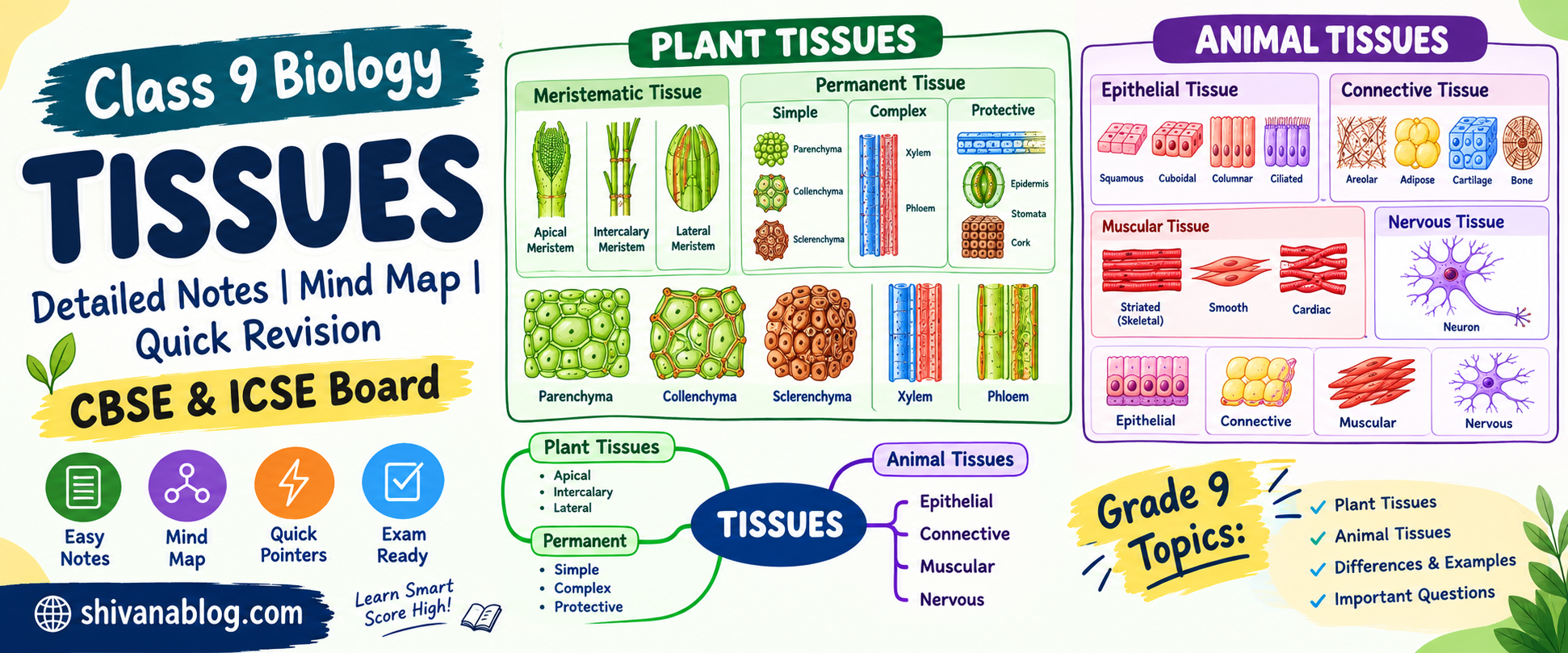
Tissues Class 9 Biology Notes – CBSE & ICSE | Complete Chapter Notes
1. What is a Tissue?
A tissue is a group of similar cells that work together to perform a specific function.
Why are tissues needed?
In multicellular organisms, different cells perform different functions. This division of labour makes the body more efficient.
Example:
- Muscle tissue → movement
- Nervous tissue → transmission of messages
- Xylem → transport of water in plants
Plant Tissues vs Animal Tissues
| Plant Tissues | Animal Tissues |
|---|---|
| Plants are generally stationary. | Animals show active movement. |
| Many tissues provide mechanical support. | Many tissues are involved in movement and coordination. |
| Growth occurs mainly in specific regions. | Growth generally occurs throughout the body during development. |
| Supporting tissues often contain dead cells. | Most functional tissues contain living cells. |
PART A – PLANT TISSUES
Plant tissues are broadly divided into:
1. Meristematic Tissue
2. Permanent Tissue
2. Meristematic Tissue
Meristematic tissue consists of actively dividing cells. It is responsible for the growth of plants.
Main characteristics
- Cells divide continuously.
- Cells are small and closely packed.
- Cell walls are thin.
- Cytoplasm is dense.
- Nucleus is prominent.
- Vacuoles are absent or very small.
- There are very few intercellular spaces.
Types of Meristematic Tissue
A. Apical Meristem
Location: Tips of roots and shoots.
Function: Increases the length of the plant.
Remember:
Apical → Apex → Length
B. Intercalary Meristem
Location: At the base of leaves or internodes, especially in grasses.
Function: Helps in increasing the length of internodes and allows rapid regrowth after grazing or cutting.
Example: Grass.
C. Lateral Meristem
Location: Along the sides of stems and roots.
Function: Increases the girth/thickness of the plant.
Example: Vascular cambium and cork cambium.
Remember:
Lateral → Lateral growth → Girth
Important comparison
| Meristem | Location | Main function |
|---|---|---|
| Apical | Root and shoot tips | Increase in length |
| Intercalary | Base of leaves/internodes | Increase in length |
| Lateral | Sides of stem/root | Increase in girth |
3. Permanent Tissue
Permanent tissues are formed from meristematic cells that lose their ability to divide and become specialised for particular functions.
This process is called differentiation.
Permanent tissues are broadly classified into:
Simple Permanent Tissue
Made up of one type of cell.
- Parenchyma
- Collenchyma
- Sclerenchyma
Complex Permanent Tissue
Made up of more than one type of cell working together.
- Xylem
- Phloem
4. Simple Permanent Tissues
A. Parenchyma
Parenchyma consists of living, thin-walled cells.
Functions
- Storage of food
- Photosynthesis when chloroplasts are present
- Repair and regeneration
- Packing tissue
Special forms
Chlorenchyma: Parenchyma containing chloroplasts; performs photosynthesis.
Aerenchyma: Parenchyma containing large air spaces; provides buoyancy to aquatic plants.
Example: Aquatic plants such as water hyacinth.
Key point
Parenchyma = Living + Storage
5. Collenchyma
Collenchyma consists of living cells with unevenly thickened cell walls, particularly at the corners.
Location
- Below the epidermis of young stems
- Leaf stalks
- Leaf veins
Functions
- Provides mechanical support.
- Provides flexibility.
- Allows bending of plant parts without breaking.
Example: Leaf stalk of celery.
Key point
Collenchyma = Support + Flexibility
6. Sclerenchyma
Sclerenchyma consists mainly of dead cells with thick, lignified walls.
Functions
- Provides mechanical strength.
- Provides rigidity and protection.
Examples
- Coconut husk
- Seed coats
- Nut shells
- Fibres around vascular tissues
Types
- Fibres
- Sclereids
Key point:
Sclerenchyma = Dead + Thick + Strong
7. Comparison of Simple Permanent Tissues
| Feature | Parenchyma | Collenchyma | Sclerenchyma |
|---|---|---|---|
| Cells | Living | Living | Dead at maturity |
| Cell wall | Thin | Unevenly thickened | Very thick and lignified |
| Main function | Storage | Support & flexibility | Strength |
| Intercellular spaces | Usually present | Very little | Usually absent |
| Special feature | May contain chloroplasts | Thickening at corners | Lignin present |
8. Protective Tissues
Protective tissues cover and protect the plant body.
A. Epidermis
The epidermis is the outermost layer of cells covering plant parts.
Functions
- Protects the plant from injury.
- Reduces water loss.
- Protects against infection.
- Helps in gas exchange through stomata.
Cuticle
The epidermis of aerial parts often has a waxy layer called the cuticle.
It helps reduce water loss.
9. Stomata
Stomata are tiny pores mainly present on the epidermis of leaves.
Each stoma is surrounded by guard cells.
Functions
- Exchange of gases
- Transpiration
Important terms
Stoma: Opening/pore
Guard cells: Control opening and closing of the stoma
Key concept
When guard cells become turgid, the stomatal pore generally opens.
When they lose water and become flaccid, the pore generally closes.
10. Cork
Cork forms a protective covering in older stems.
The cells are generally dead and compactly arranged.
They contain suberin, which makes them impermeable to water and gases.
Function
- Prevents water loss
- Protects against mechanical injury
- Provides insulation
11. Complex Permanent Tissues
Complex tissues consist of different types of cells working together.
The two major complex tissues are:
Xylem
Transports water and minerals.
Phloem
Transports food.
12. Xylem
Xylem mainly transports water and minerals from the roots to other parts of the plant.
Components of Xylem
- Tracheids
- Vessels
- Xylem fibres
- Xylem parenchyma
Important point
Xylem parenchyma is living.
Most other xylem elements are dead at maturity.
Functions
- Transport of water and minerals
- Mechanical support
13. Phloem
Phloem transports food prepared by photosynthesis from leaves to other parts of the plant.
Components
- Sieve tubes
- Companion cells
- Phloem parenchyma
- Phloem fibres
Important point
Most phloem components are living, except phloem fibres, which are dead at maturity.
Key concept
Xylem → Water + Minerals
Phloem → Food
14. Xylem vs Phloem
| Xylem | Phloem |
|---|---|
| Transports water and minerals | Transports food |
| Mainly upward movement from roots | Food can move in different directions depending on source and sink |
| Mostly dead cells | Mostly living cells |
| Provides mechanical support | Mainly conducts organic food |
| Components include vessels and tracheids | Components include sieve tubes and companion cells |
PART B – ANIMAL TISSUES
Animal tissues are broadly classified into:
- Epithelial tissue
- Connective tissue
- Muscular tissue
- Nervous tissue
15. Epithelial Tissue
Epithelial tissue forms the covering or lining of body surfaces and organs.
Functions
- Protection
- Absorption
- Secretion
- Excretion
- Exchange of substances
16. Types of Epithelial Tissue
A. Squamous Epithelium
Made of thin, flat cells.
Location
- Alveoli of lungs
- Lining of blood vessels
Function
Allows rapid diffusion and exchange of substances.
Shape: Flat
B. Stratified Squamous Epithelium
Consists of multiple layers of cells.
Location
- Skin
Function
Provides protection against mechanical damage.
Remember:
Stratified = Many layers = Protection
C. Cuboidal Epithelium
Cells are approximately cube-shaped.
Location
- Kidney tubules
- Ducts of glands
Functions
- Absorption
- Secretion
D. Columnar Epithelium
Cells are tall and column-shaped.
Location
- Lining of intestine
Functions
- Absorption
- Secretion
E. Ciliated Epithelium
Cells have cilia on their free surface.
Location
- Respiratory tract
- Oviducts/fallopian tubes
Function
Moves materials in a particular direction.
F. Glandular Epithelium
Specialised epithelial cells involved in secretion.
Function
Secretion of substances such as enzymes, mucus and hormones.
17. Connective Tissue
Connective tissue connects, supports, binds and protects different parts of the body.
It generally contains:
- Cells
- Protein fibres
- Ground substance/matrix
Major types
- Areolar tissue
- Adipose tissue
- Tendon
- Ligament
- Cartilage
- Bone
- Blood
18. Areolar Tissue
Areolar tissue is a loose connective tissue.
Location
- Between skin and muscles
- Around blood vessels and nerves
- Between internal organs
Functions
- Supports internal organs
- Fills spaces
- Helps in tissue repair
19. Adipose Tissue
Adipose tissue stores fat.
Location
- Under the skin
- Around internal organs
Functions
- Energy storage
- Insulation
- Protection of organs
20. Tendon
A tendon connects muscle to bone.
It is strong and has great tensile strength.
Remember:
Tendon → Muscle → Bone
21. Ligament
A ligament connects bone to bone at a joint.
It is strong but also flexible.
Remember:
Ligament → Bone → Bone
22. Cartilage
Cartilage is a flexible connective tissue.
Location
- Nose
- Ear
- Trachea
- Ends of bones at joints
Functions
- Provides support
- Provides flexibility
- Reduces friction at joints
23. Bone
Bone is a hard connective tissue.
Functions
- Supports the body
- Protects internal organs
- Provides attachment to muscles
- Helps in movement
- Bone marrow is involved in blood cell formation
24. Blood
Blood is a fluid connective tissue.
Components
- Plasma
- Red blood cells
- White blood cells
- Platelets
Functions
- Transport of oxygen
- Transport of nutrients
- Transport of hormones
- Defence against disease
- Blood clotting
Important concept
Blood is called connective tissue because its cells are suspended in a fluid matrix called plasma.
25. Muscular Tissue
Muscular tissue is specialised for contraction and movement.
There are three major types:
- Striated/Skeletal muscle
- Smooth/Unstriated muscle
- Cardiac muscle
26. Striated Muscle
Also called skeletal muscle.
Features
- Long, cylindrical fibres
- Unbranched
- Many nuclei
- Alternating light and dark bands
- Voluntary control
Location
Attached to bones.
Function
Movement of the skeleton.
27. Smooth Muscle
Also called unstriated muscle.
Features
- Spindle-shaped cells
- Single nucleus
- No striations
- Involuntary
Location
- Intestine
- Stomach
- Blood vessels
- Urinary bladder
Function
Movement of substances through internal organs.
28. Cardiac Muscle
Found only in the heart.
Features
- Striated
- Branched
- Usually one nucleus
- Involuntary
- Rhythmic contraction
Function
Pumps blood throughout the body.
Special feature
Cardiac muscle cells are connected by intercalated discs, which help coordinate contraction.
29. Comparison of Muscular Tissues
| Feature | Striated | Smooth | Cardiac |
|---|---|---|---|
| Striations | Present | Absent | Present |
| Shape | Long, cylindrical | Spindle-shaped | Branched |
| Control | Voluntary | Involuntary | Involuntary |
| Nuclei | Many | One | Usually one |
| Location | Attached to bones | Internal organs | Heart |
| Main function | Body movement | Movement of substances | Pumping blood |
30. Nervous Tissue
Nervous tissue is specialised for receiving and transmitting electrical signals.
The structural and functional unit is the neuron.
Main parts of a neuron
- Cell body
- Dendrites
- Axon
Functions
Dendrites: Receive signals.
Cell body: Contains the nucleus and maintains the cell.
Axon: Carries impulses away from the cell body.
Key concept
Dendrites → receive
Axon → transmit
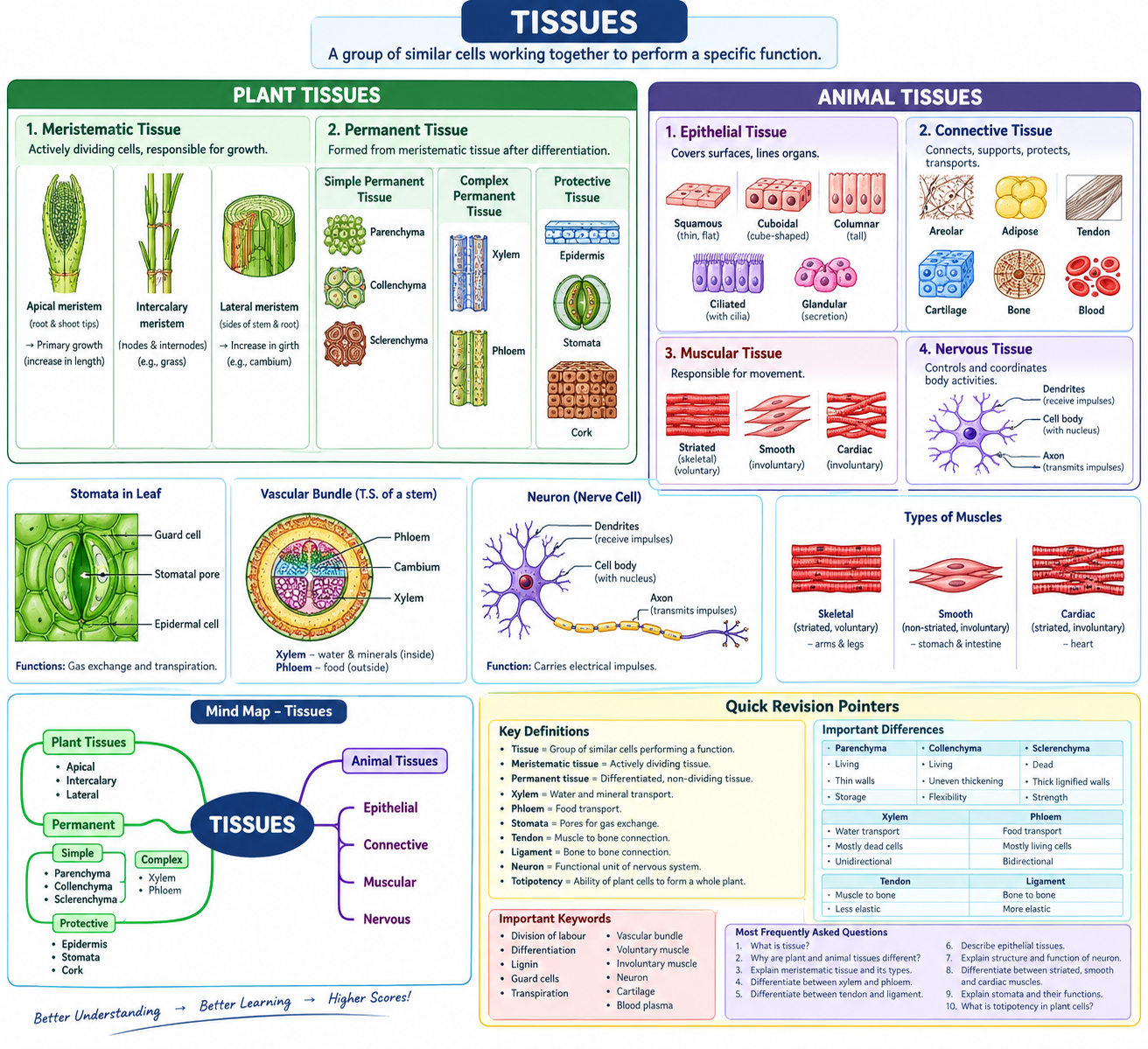
Most Frequently Asked Questions
- What is tissue?
- Why are plant and animal tissues different?
- Explain meristematic tissue and its types.
- Differentiate between xylem and phloem.
- Differentiate between tendon and ligament.
- Describe epithelial tissues.
- Explain structure and function of neuron.
- Differentiate between striated, smooth and cardiac muscles.
- Explain stomata and their functions.
- What is totipotency in plant cells?
A Note from the Author: As an educator with a background in Life Sciences and Biotechnology, I aim to simplify complex topics for students and curious minds. However, science is a rapidly evolving field. While I strive for accuracy, please use these resources as a supplement to—not a replacement for—official curriculum textbooks or professional medical consultation.