



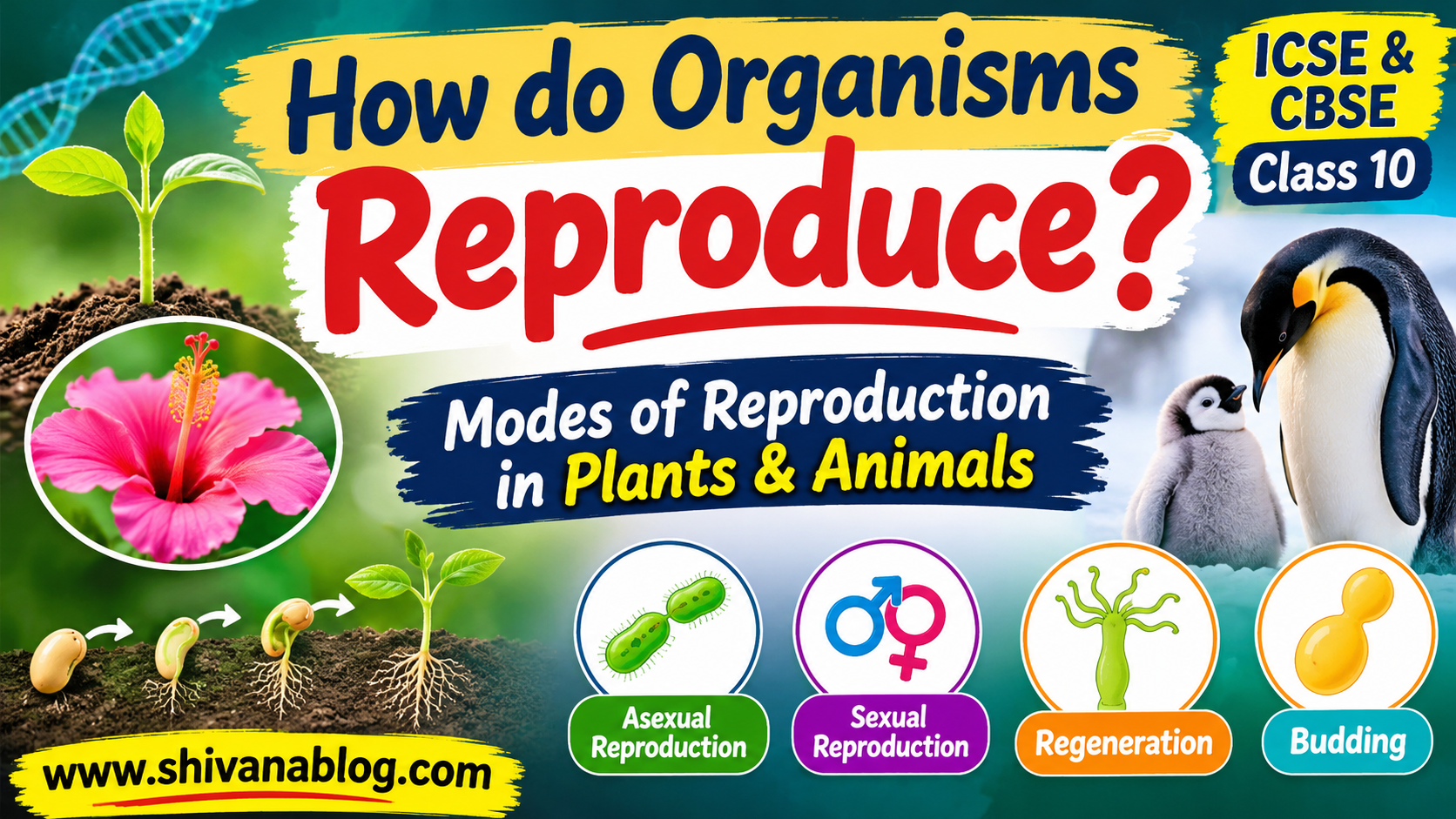
Above all the explanations are student-friendly, with special emphasis on scientific terminology and answers that students can reproduce in their board examinations.
1. Introduction to Reproduction
Reproduction is the biological process by which living organisms produce new individuals of their own kind. It is an essential characteristic of living organisms that ensures the continuity of a species from one generation to the next.
Importance of reproduction
-
Ensures the continuity of a species.
-
Transfers hereditary information (DNA) from parents to offspring.
-
Produces variations among individuals.
-
Helps organisms adapt to changing environmental conditions.
-
Plays an important role in evolution.
Why is reproduction not essential for the survival of an individual?
An individual organism can survive without reproducing. However, reproduction is essential for the survival and continuity of a species.
2. Types of Reproduction
There are two main types of reproduction:
Types of Reproduction
Involves a single parent. No formation or fusion of gametes.
Sexual Reproduction
Generally involves two parents and fusion of male and female gametes.
A. Asexual Reproduction
Asexual reproduction is a type of reproduction in which a single parent produces offspring without the formation and fusion of gametes.
The offspring produced are genetically almost identical to the parent and are called clones.
Characteristics
-
Involves only one parent.
-
Gamete formation and fertilisation do not occur.
-
Usually involves mitotic cell division.
-
Offspring are genetically similar to the parent.
-
It is a rapid method of reproduction.
Methods of Asexual Reproduction
1. Binary Fission
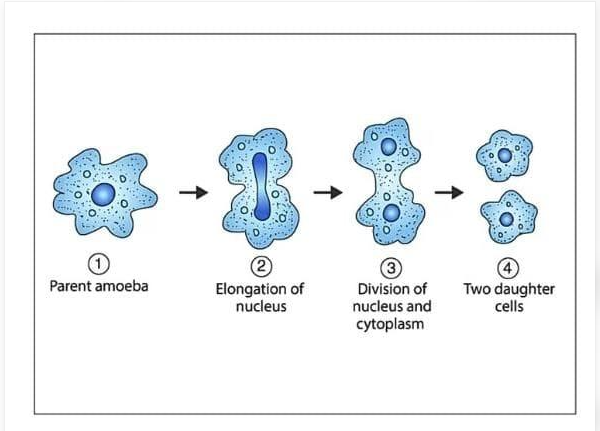
Binary fission is a type of asexual reproduction in which one parent organism divides into two nearly equal daughter individuals.
Examples:
-
Amoeba – division can occur in any plane.
-
Leishmania – division occurs in a definite longitudinal plane.
-
Paramecium – transverse binary fission.
Process in Amoeba:
-
The nucleus divides into two daughter nuclei.
-
The cytoplasm divides.
-
Two daughter Amoebae are formed.
2. Multiple Fission
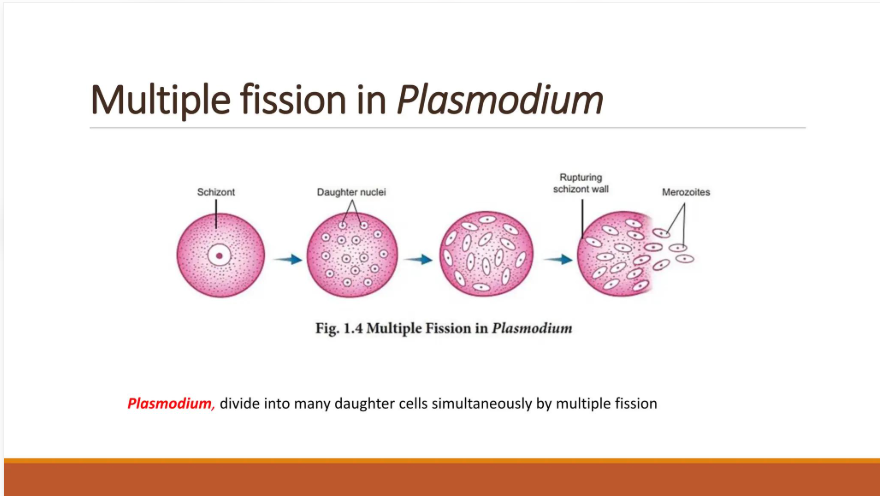
Multiple fission is a type of asexual reproduction in which the nucleus divides repeatedly to form many daughter nuclei, followed by division of the cytoplasm.
Example: Plasmodium.
Process:
-
The nucleus divides repeatedly inside the parent cell.
-
Cytoplasm surrounds each daughter nucleus.
-
Many daughter cells are formed.
-
The parent cell membrane breaks and releases them.
3. Fragmentation
Fragmentation is a type of asexual reproduction in which the body of an organism breaks into two or more fragments, and each fragment develops into a complete organism.
Example: Spirogyra.
4. Regeneration
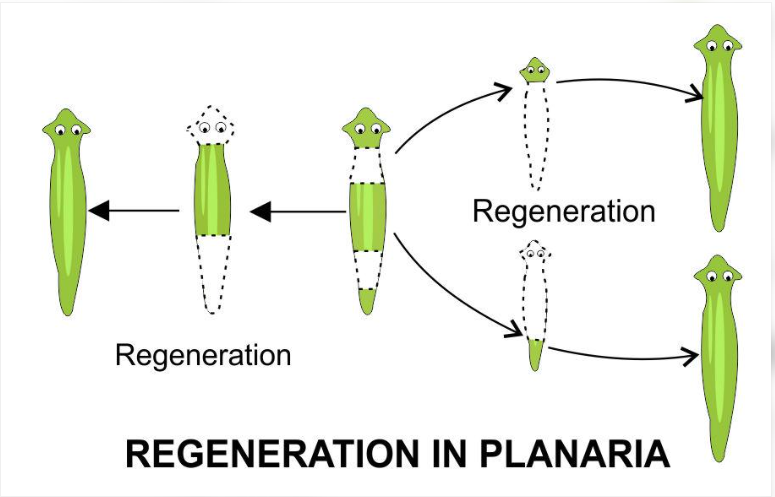
Regeneration is the ability of an organism to develop a complete new individual from a body fragment through the activity of specialised cells.
Examples: Planaria and Hydra (regeneration in Planaria is particularly well known).
Important: Regeneration is not the usual method of reproduction in all organisms. In some organisms, specialised regenerative abilities can also result in the formation of new individuals.
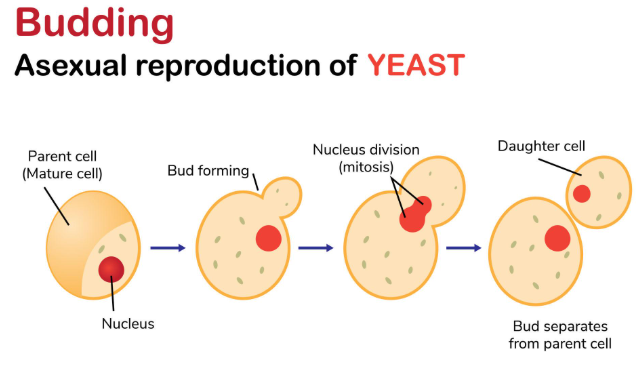
5. Budding
Budding is a type of asexual reproduction in which a small outgrowth called a bud develops on the parent body. The bud grows and eventually separates to form a new individual.
Examples: Hydra and Yeast.
-
Repeated cell division at a specific site produces a bud.
-
The bud grows and develops tentacles and a mouth.
-
The mature bud separates from the parent.
-
It develops into an independent Hydra.
6. Spore Formation
Spore formation is a method of asexual reproduction in which an organism produces tiny reproductive structures called spores.
Example: Rhizopus (bread mould).
Process:
-
Specialised structures called sporangia develop at the tips of hyphae.
-
Spores are formed inside the sporangia.
-
On maturity, the sporangium bursts and releases spores.
-
Under favourable conditions, spores germinate to form new organisms.
Adaptation of spores:
-
Thick protective walls.
-
Can survive unfavourable environmental conditions.
-
Lightweight and easily dispersed by air.
7. Vegetative Propagation
Vegetative propagation is a type of asexual reproduction in plants in which new plants develop from vegetative parts such as roots, stems and leaves.
Examples:
| Plant part | Examples |
|---|---|
| Root | Sweet potato, Dahlia |
| Stem | Potato, Ginger, Sugarcane |
| Leaf | Bryophyllum, Begonia |
Advantages of vegetative propagation
-
Produces genetically similar plants.
-
Plants mature and bear flowers or fruits earlier than seed-grown plants in many cases.
-
Useful for propagating plants that do not produce viable seeds.
-
Helps preserve desirable characteristics of parent plants.
-
Large numbers of plants can be produced quickly.
Artificial Methods of Vegetative Propagation
-
Cutting: Rose, sugarcane.
-
Layering: Jasmine, bougainvillea.
-
Grafting: Mango, citrus.
-
Tissue culture: Orchids, banana.
3. Sexual Reproduction
Sexual reproduction is a type of reproduction in which male and female gametes fuse to form a zygote, which develops into a new organism.
Characteristics of sexual reproduction
-
Generally involves two parents.
-
Male and female gametes are produced.
-
Fertilisation takes place.
-
A zygote is formed.
-
Offspring show genetic variations.
-
It plays an important role in evolution.
Difference between Asexual and Sexual Reproduction
| Asexual reproduction | Sexual reproduction |
|---|---|
| Usually involves one parent. | Generally involves two parents. |
| Gametes are not formed. | Gametes are formed. |
| Fertilisation does not occur. | Fertilisation occurs. |
| Usually involves mitosis. | Involves meiosis in gamete formation and mitosis during growth. |
| Offspring are genetically similar. | Offspring show genetic variations. |
| Generally faster. | Generally slower. |
| Example: Amoeba, Hydra. | Example: Humans, flowering plants. |
4. Sexual Reproduction in Flowering Plants
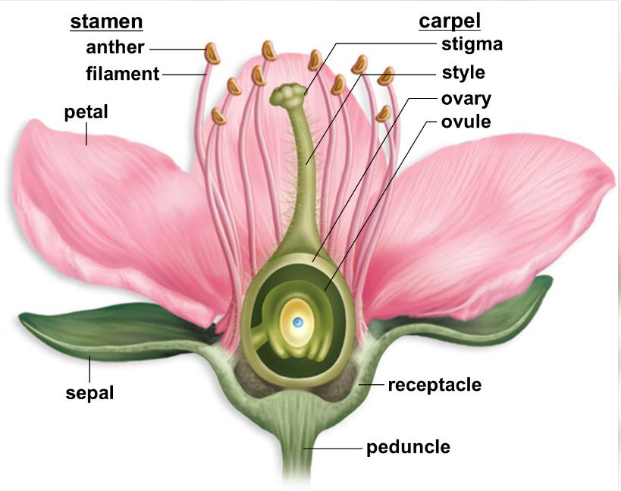
The flower is the reproductive organ of an angiosperm (flowering plant).
A typical flower consists of four main whorls:
Parts of a Flower
| Floral whorl | Structure | Function |
|---|---|---|
| Calyx | Sepals | Protects the flower in the bud stage. |
| Corolla | Petals | Attracts pollinators. |
| Androecium | Stamens | Male reproductive whorl. |
| Gynoecium | Carpels/Pistil | Female reproductive whorl. |
A. Male Reproductive Part – Stamen
The stamen consists of:
-
Anther: Produces pollen grains containing the male reproductive cells.
-
Filament: A slender stalk that supports the anther.
Pollen grains: These are microscopic structures produced in the anther. They carry the male gametophyte.
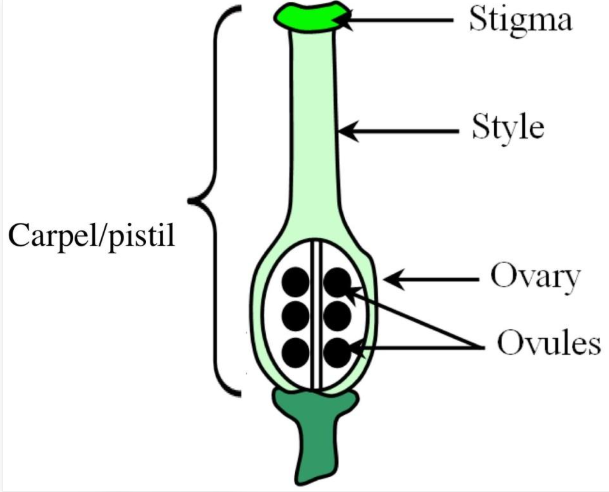
B. Female Reproductive Part – Pistil/Carpel
The pistil consists of three main parts:
-
Stigma: Sticky upper part that receives pollen grains.
-
Style: Slender stalk connecting stigma to ovary.
-
Ovary: Swollen basal part containing ovules.
Ovule: Contains the female gametophyte (embryo sac), which contains the egg cell.
Pollination
Pollination is the transfer of pollen grains from the anther to the stigma of a flower.
Types of Pollination
1. Self-pollination: Transfer of pollen grains from the anther to the stigma of the same flower or another flower on the same plant.
2. Cross-pollination: Transfer of pollen grains from the anther of one plant to the stigma of a flower on another plant of the same species.
Agents of Pollination
-
Wind – Maize, grasses.
-
Water – Vallisneria, Hydrilla.
-
Insects – Sunflower, Salvia.
-
Birds – Some tubular flowers.
Difference between Self-pollination and Cross-pollination
| Self-pollination | Cross-pollination |
|---|---|
| Takes place within the same plant. | Takes place between two different plants of the same species. |
| Usually does not require external agents. | Often requires external agents. |
| Produces less genetic variation. | Produces greater genetic variation. |
| Less pollen is wasted. | More pollen may be wasted. |
Fertilisation in Flowering Plants
Fertilisation is the fusion of the male gamete with the female gamete to form a diploid zygote.
Steps:
-
Pollen grains land on the stigma.
-
A pollen tube develops and grows through the style.
-
The pollen tube reaches the ovule through the micropyle.
-
Two male gametes enter the embryo sac.
-
One male gamete fuses with the egg cell to form the diploid zygote.
-
The other male gamete fuses with the two polar nuclei to form the triploid primary endosperm nucleus.
This process is called double fertilisation, a characteristic feature of angiosperms.
Changes After Fertilisation
| Before fertilisation | After fertilisation |
|---|---|
| Ovary | Fruit |
| Ovule | Seed |
| Zygote | Embryo |
| Integuments | Seed coat |
| Primary endosperm nucleus | Endosperm |
Important terms
-
Zygote: First diploid cell formed after fertilisation.
-
Embryo: Young developing plant formed from the zygote.
-
Seed: Mature fertilised ovule.
-
Fruit: Mature ovary.
-
Endosperm: Nutritive tissue that provides nourishment to the developing embryo.
5. Human Reproductive System
Humans reproduce sexually. They are viviparous organisms, meaning they give birth to young ones.
Humans show sexual dimorphism, meaning males and females have distinct reproductive structures.
A. Male Reproductive System
The male reproductive system consists of the following organs:
1. Testes
-
A pair of oval-shaped organs located in the scrotum.
-
Produce sperms.
-
Secrete the male sex hormone testosterone.
-
The scrotum maintains the temperature of testes about 2–2.5°C below normal body temperature, which is essential for sperm production.
2. Scrotum
-
A pouch of skin outside the abdominal cavity.
-
Holds and protects the testes.
-
Maintains a suitable temperature for sperm formation.
3. Epididymis
-
A long, coiled tube attached to each testis.
-
Stores sperms and allows them to mature.
4. Vas Deferens
– A muscular tube that transports sperms from the epididymis towards the urethra.
5. Seminal Vesicles
-
Secrete seminal fluid containing fructose.
-
Provide nourishment and energy to sperms.
6. Prostate Gland
-
Adds an alkaline secretion to semen.
-
Helps sperm motility and survival.
7. Urethra
– Common passage for urine and semen in males, although not simultaneously.
8. Penis
-
External reproductive organ.
-
Transfers semen into the female reproductive tract.
Sperm – Structure
A sperm is the male gamete. It is microscopic and motile.
Parts of sperm:
| Part | Function |
|---|---|
| Head | Contains haploid nucleus. |
| Acrosome | Contains enzymes that help sperm penetrate egg coverings. |
| Middle piece | Contains mitochondria that provide energy. |
| Tail | Helps in movement. |
B. Female Reproductive System
The female reproductive system consists of:
1. Ovaries
-
A pair of female reproductive organs.
-
Produce ova (eggs).
-
Secrete oestrogen and progesterone.
-
Each ovary contains developing ovarian follicles.
2. Fallopian Tubes / Oviducts
-
Two tubes that connect the region near the ovaries to the uterus.
-
Receive the ovum released during ovulation.
-
Usual site of fertilisation is the ampullary region of the oviduct.
3. Uterus
-
A hollow, muscular, pear-shaped organ.
-
Receives the fertilised egg.
-
Supports implantation and development of the embryo.
4. Cervix
-
Narrow lower part of the uterus.
-
Connects the uterus with the vagina.
5. Vagina
-
Muscular, elastic tube.
-
Receives sperms during copulation.
-
Acts as the birth canal and passage for menstrual flow.
Structure of Ovum
The ovum is the female gamete. It is larger than the sperm and is non-motile.
It contains a haploid nucleus, cytoplasm and protective coverings.
Difference between Male and Female Gametes
| Sperm | Ovum |
|---|---|
| Male gamete. | Female gamete. |
| Small in size. | Large in size. |
| Motile. | Non-motile. |
| Produced in testes. | Produced in ovaries. |
| Has a head, middle piece and tail. | Has a spherical cell body. |
| Haploid (23 chromosomes in humans). | Haploid (23 chromosomes in humans). |
6. Puberty and Secondary Sexual Characters
Puberty is the stage at which a child undergoes physical and hormonal changes and becomes sexually mature.
Changes in Boys
-
Growth of facial and body hair.
-
Voice becomes deeper.
-
Shoulders broaden.
-
Testes and penis enlarge.
-
Sperm production begins.
-
Increased muscle development.
Changes in Girls
-
Development of breasts.
-
Hips become broader.
-
Growth of hair in armpits and pubic region.
-
Ovaries begin to release mature ova.
-
Menstruation begins.
Hormones involved
| Hormone | Function |
|---|---|
| Testosterone | Development of male reproductive organs and secondary sexual characters. |
| Oestrogen | Development of female secondary sexual characters. |
| Progesterone | Maintains the uterine lining and supports pregnancy. |
| FSH | Stimulates development of ovarian follicles and spermatogenesis. |
| LH | Triggers ovulation in females and stimulates testosterone secretion in males. |
7. Menstrual Cycle
The menstrual cycle is a series of cyclic changes that occur in the female reproductive system, usually approximately every 28 days.
It prepares the uterus for possible pregnancy.
Main phases of the menstrual cycle
1. Menstrual phase (approximately days 1–5): The uterine lining breaks down and is discharged along with blood and mucus through the vagina.
2. Follicular phase (approximately days 1–13): FSH stimulates the development of ovarian follicles. Oestrogen helps rebuild and thicken the uterine lining.
3. Ovulation (around day 14 in a typical 28-day cycle): A mature ovum is released from the ovary due to a surge in LH.
4. Luteal phase (approximately days 15–28): The corpus luteum secretes progesterone, which maintains the uterine lining.
What happens if fertilisation does not occur?
-
The corpus luteum degenerates.
-
Progesterone and oestrogen levels decrease.
-
The uterine lining breaks down.
-
Menstruation begins again.
What happens if fertilisation occurs?
-
The embryo develops and implants in the uterine wall.
-
hCG hormone maintains the corpus luteum initially.
-
The uterine lining is maintained.
-
Menstruation stops during pregnancy.
8. Fertilisation and Development in Humans
Fertilisation: Fusion of a haploid male gamete (sperm) and a haploid female gamete (ovum) to form a diploid zygote.
Steps involved:
-
During copulation, semen is deposited in the vagina.
-
Sperms travel through the cervix and uterus into the fallopian tube.
-
Fertilisation usually occurs in the ampullary region of the fallopian tube.
-
The sperm fuses with the ovum to form a diploid zygote.
-
The zygote undergoes repeated mitotic divisions called cleavage.
-
It develops into a morula and then a blastocyst.
-
The blastocyst reaches the uterus and gets embedded in the endometrium. This process is called implantation.
Development of Embryo
-
The zygote develops into an embryo.
-
The embryo differentiates into different tissues and organs.
-
After approximately eight weeks of development, it is generally referred to as a foetus.
-
The foetus continues to grow inside the uterus.
Placenta
The placenta is a temporary vascular organ that connects the developing foetus with the uterine wall.
Functions of placenta
-
Supplies oxygen and nutrients to the foetus.
-
Removes carbon dioxide and metabolic wastes from foetal blood.
-
Produces hormones that help maintain pregnancy.
-
Allows exchange of substances between maternal and foetal blood without their normal direct mixing.
Umbilical cord: Connects the foetus to the placenta and contains blood vessels that transport blood between them.
9. Reproductive Health
Reproductive health refers to the total well-being of an individual in all aspects of reproduction, including physical, emotional and social well-being.
A. Methods of Contraception
Contraception refers to methods used to prevent unwanted pregnancy.
1. Barrier Methods
-
Male condoms.
-
Female condoms.
-
Diaphragms.
They prevent sperm from reaching the ovum. Condoms also help reduce the risk of sexually transmitted infections (STIs).
2. Hormonal Methods
-
Oral contraceptive pills.
-
Hormonal implants.
-
Injectable contraceptives.
They prevent pregnancy by interfering with ovulation and other reproductive processes.
3. Intrauterine Devices (IUDs)
Examples:
-
Copper-T.
-
Hormone-releasing IUDs.
They are placed inside the uterus by trained healthcare professionals.
4. Surgical Methods
-
Vasectomy: A small portion of the vas deferens is cut or blocked in males.
-
Tubectomy: The fallopian tubes are cut or blocked in females.
These are generally considered permanent methods of contraception.
B. Sexually Transmitted Infections (STIs)
STIs are infections that spread mainly through sexual contact.
Examples:
| Disease | Causative organism |
|---|---|
| Gonorrhoea | Bacteria |
| Syphilis | Bacteria |
| HIV/AIDS | Human Immunodeficiency Virus |
| Genital herpes | Herpes simplex virus |
| Hepatitis B | Hepatitis B virus |
Prevention
-
Use condoms correctly and consistently.
-
Avoid sharing needles.
-
Ensure screened blood is used for transfusions.
-
Seek timely medical advice, testing and treatment.
-
Promote awareness and responsible reproductive behaviour.
Important: HIV is not spread through casual contact such as hugging, sharing food or sitting together.
10. Sexually Transmitted Infections (STIs): Important Differences
| Bacterial infections | Viral infections |
|---|---|
| Gonorrhoea | HIV/AIDS |
| Syphilis | Genital herpes |
| Can generally be treated with appropriate antibiotics. | Antibiotics are ineffective against viruses. |
| Require early diagnosis and medical treatment. | Treatment depends on the specific viral infection. |
Board examination point: Antibiotics should not be used to treat viral infections such as HIV or genital herpes.
11. Important Differences for Board Examinations
These comparison-based questions are frequently useful for 2–3 mark answers.
1. Ovule and Seed
| Ovule | Seed |
|---|---|
| Present inside the ovary before fertilisation. | Develops from the fertilised ovule. |
| Contains the female gametophyte. | Contains an embryo and stored food or nutritive tissue. |
| Protected by integuments. | Protected by a seed coat. |
2. Ovary and Ovule
| Ovary | Ovule |
|---|---|
| Part of the female reproductive organ of a flower. | Structure present inside the ovary. |
| Develops into fruit. | Develops into seed. |
| Contains one or more ovules. | Contains the female gametophyte. |
3. Pollination and Fertilisation
| Pollination | Fertilisation |
|---|---|
| Transfer of pollen grains from anther to stigma. | Fusion of male and female gametes. |
| Occurs before fertilisation. | Occurs after pollination in flowering plants. |
| Does not involve fusion of gametes. | Involves fusion of gametes. |
| May require agents such as wind, water or insects. | Involves the fusion of gametes within the embryo sac. |
4. Embryo and Foetus
| Embryo | Foetus |
|---|---|
| Early developing stage of the organism. | Later developing stage of the organism. |
| Major organs begin to develop and differentiate. | Major body structures are recognisable. |
| In humans, used for the first approximately eight weeks of development. | Used after the embryonic period. |
5. Vasectomy and Tubectomy
| Vasectomy | Tubectomy |
|---|---|
| Male sterilisation method. | Female sterilisation method. |
| Vas deferens is cut or blocked. | Fallopian tubes are cut or blocked. |
| Prevents sperms from entering semen. | Prevents sperm and ovum from meeting. |
6. Regeneration and Fragmentation
| Regeneration | Fragmentation |
|---|---|
| New body parts or individuals develop from body fragments through specialised regenerative cells. | Body breaks into fragments and each fragment grows into a new individual. |
| Example: Planaria. | Example: Spirogyra. |
12. Important Biological Terms – How Do Organisms Reproduce Biology Notes | CBSE & ICSE
| Term | Definition |
|---|---|
| Reproduction | Production of new individuals of the same species. |
| Gametes | Reproductive cells involved in sexual reproduction. |
| Zygote | Diploid cell formed after fertilisation. |
| Clone | Genetically identical or nearly identical copy of an organism. |
| Fission | Division of a parent organism into daughter individuals. |
| Budding | Formation of a new organism through an outgrowth called a bud. |
| Fragmentation | Breaking of the body into fragments that develop into new individuals. |
| Regeneration | Development of a complete organism or body part from a fragment. |
| Pollination | Transfer of pollen grains from anther to stigma. |
| Fertilisation | Fusion of male and female gametes. |
| Implantation | Embedding of the blastocyst in the uterine lining. |
| Ovulation | Release of a mature ovum from the ovary. |
| Menstruation | Periodic shedding of the uterine lining. |
| Placenta | Temporary organ connecting the foetus with the uterine wall for exchange of substances. |
| Puberty | Stage at which reproductive maturity is attained. |
| Contraception | Prevention of pregnancy through various methods. |
| Vegetative propagation | Formation of new plants from vegetative parts. |