



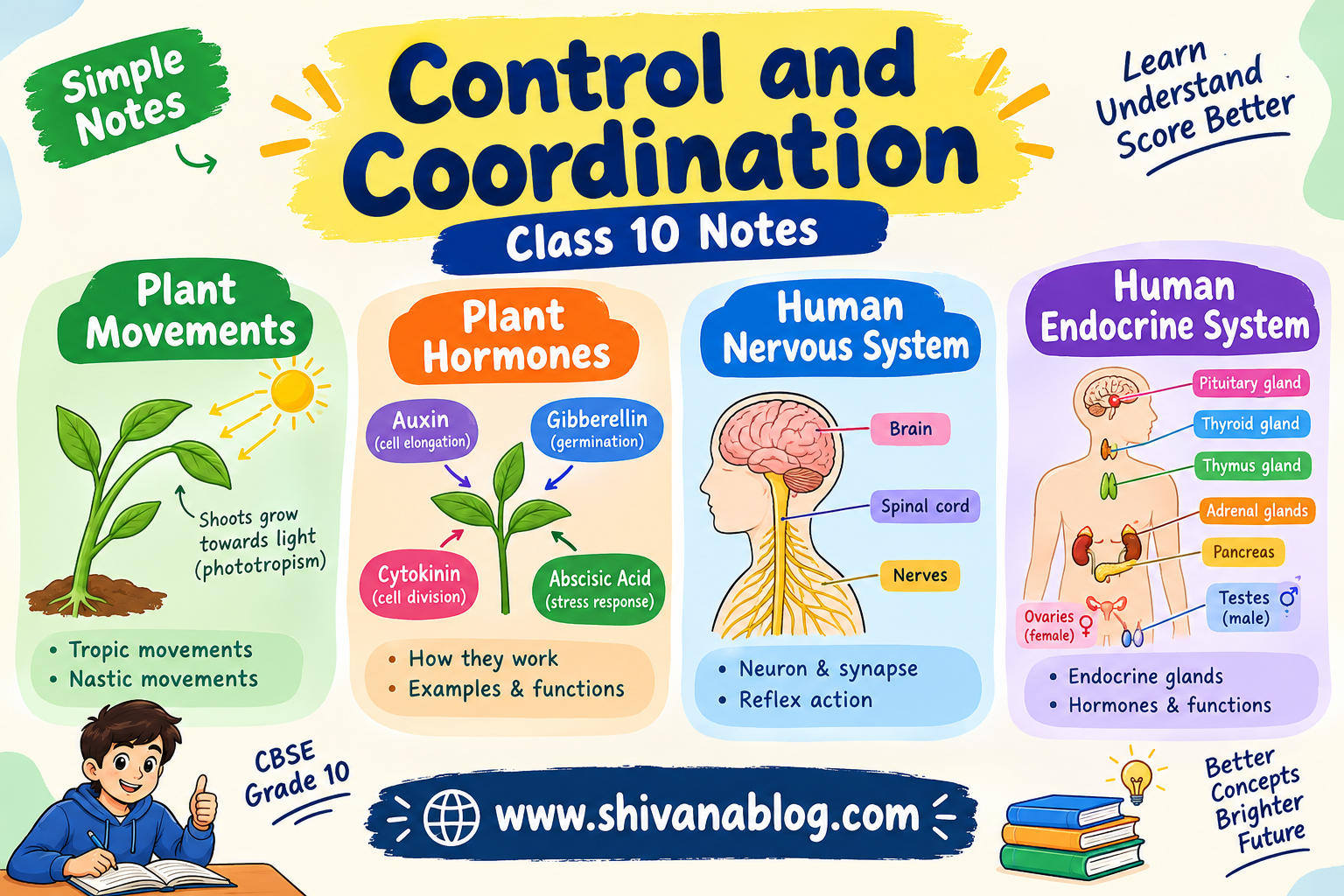
Here are Control and Coordination Class 10 Notes, covering plant movements, plant hormones, and the human nervous and endocrine systems. They include important definitions, labelled diagrams, examples and exam-ready points for revision.
Control and Coordination — Grade 10 Biology

1. Control and coordination in plants
How plants respond to light, gravity, water and touch, and how plant hormones regulate growth.

2. Human nervous system
Neurons, the brain, spinal cord, reflex actions and the transmission of nerve impulses.

3. Human endocrine system
Hormones, endocrine glands, feedback mechanisms and the regulation of body functions.
1. Meaning of control and coordination
-
Control: Regulation of different activities of an organism.
-
Coordination: Working together of different organs and systems to produce an appropriate response to a stimulus.
-
Stimulus: Any change in the surroundings that causes a response, such as light, heat, touch or gravity.
-
Response: The reaction of an organism to a stimulus.
Examples: A plant shoot bends towards light, and a person withdraws their hand from a hot object.
2. Control and coordination in plants
Plants do not have a nervous system or brain. They coordinate their activities mainly through plant hormones and changes in growth or movement.
A. Types of plant movements
1. Tropic movements
A tropic movement is a directional growth movement in response to a stimulus.
-
Positive tropism: Growth towards the stimulus.
-
Negative tropism: Growth away from the stimulus.
Phototropism — response to light
-
Shoots generally grow towards light (positive phototropism).
-
Roots are generally negatively phototropic.
-
Auxin causes greater cell elongation on the shaded side of a shoot, making it bend towards light.

Geotropism (gravitropism) — response to gravity
-
Roots grow towards gravity (positive geotropism).
-
Shoots grow away from gravity (negative geotropism).

Hydrotropism — response to water
Roots grow towards a source of water, helping the plant absorb water.

Thigmotropism — response to touch
Tendrils of climbing plants coil around a support when they touch it.
2. Nastic movements
Nastic movements are movements in which the direction of the response does not depend on the direction of the stimulus.
Example: The leaves of Mimosa pudica (touch-me-not) fold when touched. This happens mainly because of changes in water pressure in certain cells, rather than directional growth.
B. Plant movements: comparison
| Feature | Tropic movement | Nastic movement |
|---|---|---|
| Direction | Depends on direction of stimulus | Does not depend on direction of stimulus |
| Nature | Often a growth response | Often due to changes in water pressure or cell movement |
| Example | Shoot bending towards light | Mimosa leaves folding on touch |
C. Plant hormones (phytohormones)
Plant hormones are chemical substances produced in small amounts that regulate growth, development and responses to stimuli.
| Hormone | Main function | Example / effect |
|---|---|---|
| Auxin | Promotes cell elongation | Helps shoots bend towards light |
| Gibberellin | Promotes stem growth and seed germination | Increases stem length |
| Cytokinin | Promotes cell division | Supports growth of new tissues |
| Abscisic acid (ABA) | Generally inhibits growth and promotes dormancy; helps plants respond to stress | Causes stomatal closure during water stress |
Important: Ethylene is also a plant hormone. It promotes fruit ripening.
D. Diagram: phototropism in a shoot
Remember: Plant hormones coordinate plant activities chemically; plants do not use nerves like humans do.
3. Human nervous system
The nervous system receives information, processes it and coordinates rapid responses using electrical impulses and chemical neurotransmitters.
A. Neuron — the structural and functional unit
A neuron is a specialised nerve cell that transmits nerve impulses.

Parts of a neuron
-
Dendrites: Receive signals.
-
Cell body: Contains the nucleus and maintains the cell.
-
Axon: Carries impulses away from the cell body.
-
Myelin sheath: Insulates the axon and helps impulses travel faster in many neurons.
-
Nerve endings: Pass signals to another neuron, muscle or gland.
Direction of impulse:
Dendrites
Cell body
Axon
Nerve endings
B. Types of neurons
-
Sensory neurons: Carry impulses from receptors to the central nervous system (CNS).
-
Relay neurons (interneurons): Connect neurons within the CNS.
-
Motor neurons: Carry impulses from the CNS to muscles or glands.
C. Main parts of the human nervous system
Nervous system
Central nervous system (CNS)
Brain and spinal cord
Peripheral nervous system (PNS)
Nerves connecting CNS to the body
D. The human brain
The brain is protected by the skull, three protective membranes called meninges, and cerebrospinal fluid (CSF).

1. Forebrain — cerebrum
-
Thinking, memory, intelligence and learning.
-
Interprets sensory information.
-
Controls voluntary actions, such as writing and walking.

2. Midbrain and brainstem
-
Help coordinate certain visual and auditory reflexes.
-
The pons and medulla help regulate breathing and other involuntary activities.

3. Hindbrain — cerebellum
-
Maintains posture and balance.
-
Coordinates precise movements of muscles.
E. The spinal cord
-
Forms part of the CNS and is protected by the vertebral column.
-
Carries nerve impulses between the brain and the body.
-
Coordinates many reflex actions.
F. Reflex action and reflex arc
A reflex action is a rapid, automatic response to a stimulus. It helps protect the body from harm.
Example: Quickly withdrawing your hand after touching a hot object.
G. Voluntary, involuntary and reflex actions
| Type | Meaning | Example |
|---|---|---|
| Voluntary | Under conscious control | Writing |
| Involuntary | Not normally under conscious control | Heartbeat |
| Reflex | Rapid, automatic response to a stimulus | Withdrawal from a hot object |
H. How a nerve impulse crosses a synapse
A synapse is the junction between two neurons or between a neuron and another target cell.
-
An electrical impulse reaches the nerve ending.
-
Chemical messengers called neurotransmitters are released.
-
They cross the tiny gap between cells.
-
They bind to receptors on the next cell and may trigger a new impulse.
This allows signals to pass from one neuron to another.
4. Human endocrine system
The endocrine system is a collection of glands that release chemical messengers called hormones into the bloodstream.
Hormones regulate growth, metabolism, reproduction, stress responses and other body functions.
A. Important endocrine glands and their hormones

| Gland | Hormone | Main function |
|---|---|---|
| Pituitary gland | Growth hormone (GH) | Promotes growth of the body |
| Thyroid gland | Thyroxine | Regulates metabolism |
| Pancreas | Insulin | Lowers blood glucose level |
| Adrenal glands | Adrenaline | Prepares the body for emergency situations |
| Testes | Testosterone | Development of male secondary sexual characteristics |
| Ovaries | Oestrogen | Development of female secondary sexual characteristics |
Important facts
-
The pituitary gland is often called the master gland because it regulates several other endocrine glands. However, it is itself controlled in part by the hypothalamus.
-
The thyroid gland needs iodine to produce thyroxine. Iodine deficiency can cause goitre.
-
Insufficient insulin production or ineffective insulin action can lead to diabetes mellitus.
-
Adrenaline increases heart rate and breathing rate and helps prepare the body for a fight-or-flight response.
-
The pancreas has both endocrine functions (hormone secretion) and digestive functions.
B. How hormones work
- Endocrine gland
- Hormone released into blood
- Target organ or target cells
- Specific response
- Hormones travel through the blood, but they act mainly on cells that have suitable receptors.
C. Feedback mechanism — regulation of blood sugar
The body maintains a relatively stable blood glucose level using insulin and glucagon.
-
When blood glucose rises after a meal, the pancreas releases insulin, which helps lower it.
-
When blood glucose falls, the pancreas releases glucagon, which helps raise it.
This is an example of negative feedback, which brings a changing condition back towards its normal range.
D. Adolescence and sex hormones
At puberty, hormones bring about physical and reproductive changes.
-
Testosterone: Produced mainly by the testes; promotes facial hair, a deeper voice and other male secondary sexual characteristics.
-
Oestrogen: Produced mainly by the ovaries; promotes breast development and other female secondary sexual characteristics.
The onset and pace of puberty vary from person to person.
5. Nervous system vs endocrine system
| Feature | Nervous system | Endocrine system |
|---|---|---|
| Messenger | Electrical impulses and neurotransmitters | Hormones |
| Pathway | Neurons and nerves | Bloodstream |
| Speed | Usually very fast | Often slower |
| Duration | Often short-lived | Often longer-lasting |
| Effect | Usually localised and precise | May affect multiple target organs |
| Example | Withdrawing hand from heat | Regulation of growth by growth hormone |
Both systems work together to maintain coordination and homeostasis — a relatively stable internal environment.
6. Important diagrams to practise for exams
Practise drawing these diagrams neatly with labels:

Diagram 1: Phototropism
Labels: light, shoot, shaded side, greater cell elongation.

Diagram 2: Neuron
Labels: dendrites, cell body, nucleus, axon, myelin sheath, nerve endings.

Diagram 3: Reflex arc
Labels: receptor, sensory neuron, spinal cord, relay neuron, motor neuron, effector.

Labels: pituitary, thyroid, adrenal glands, pancreas, testes or ovaries.
7. Quick revision — important questions
1. What is a stimulus?
2. What is phototropism?
3. Name four plant hormones and their functions.
4. What is a neuron?
5. What is a reflex arc?
6. What are the main functions of the cerebrum and cerebellum?
7. Why is the pituitary gland called the master gland?
8. What is the function of insulin?
9. How does the nervous system differ from the endocrine system?
10. What is a synapse?
A Note from the Author: As an educator with a background in Life Sciences and Biotechnology, I aim to simplify complex topics for students and curious minds. However, science is a rapidly evolving field. While I strive for accuracy, please use these resources as a supplement to—not a replacement for—official curriculum textbooks or professional medical consultation.