



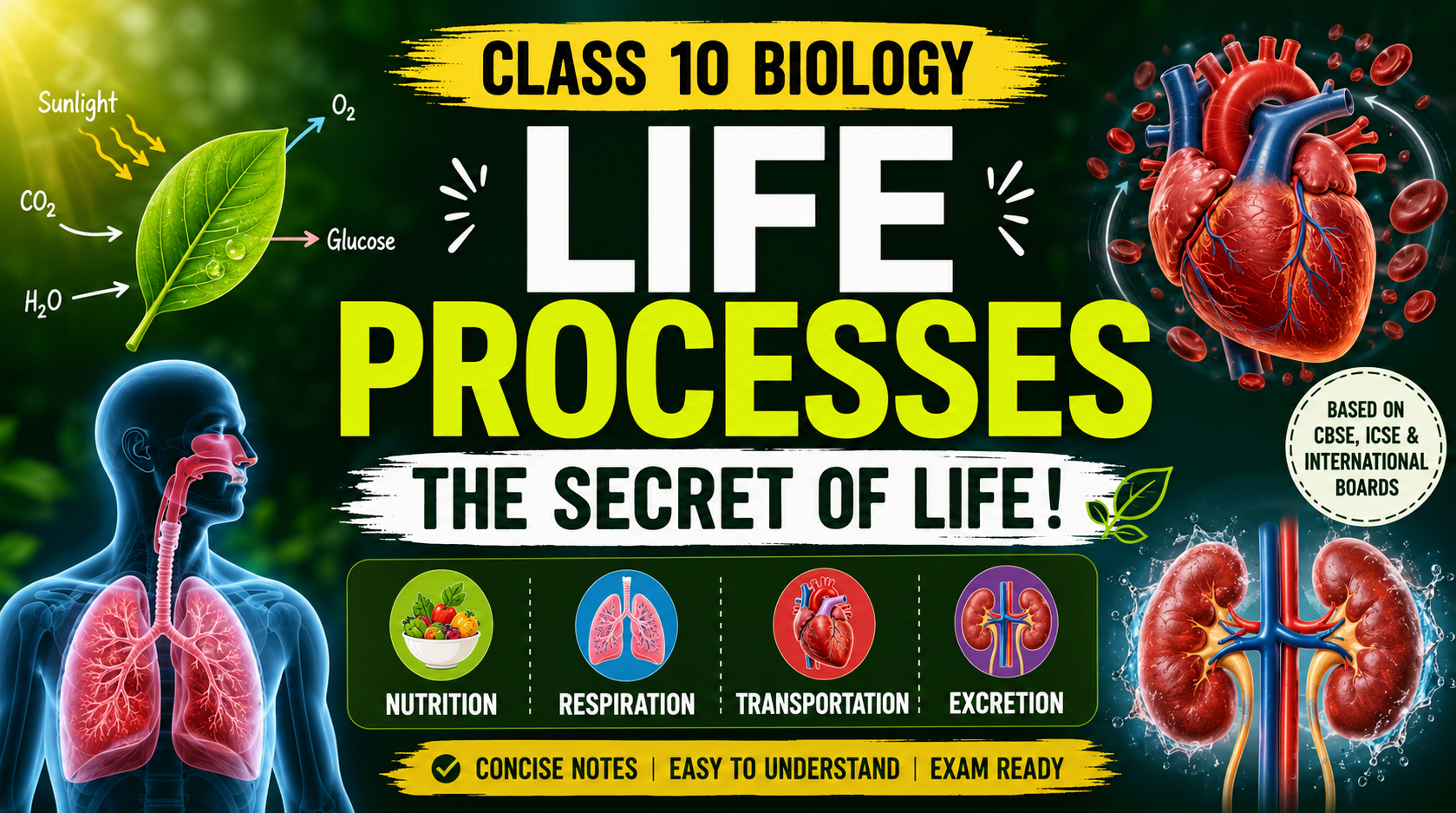
Life Processes Class 10 are the essential activities that help living organisms survive, grow, and maintain life. Every living organism performs four major life processes: Nutrition, Respiration, Transportation and Excretion.
What Makes an Organism Living?
Living organisms show the following characteristics:
- Growth
- Movement
- Nutrition
- Respiration
- Excretion
- Reproduction
- Response to stimuli
- Cellular organization
1. Nutrition
Definition
It is the process by which organisms obtain food and use it for energy, growth, and repair.
Types of Nutrition
Autotrophic Nutrition
- Organisms prepare their own food.
- Seen in green plants.
- Food is produced through photosynthesis.
Photosynthesis Equation
CO₂ + H₂O + Sunlight → Glucose + O₂
Heterotrophic Nutrition
- Organisms depend on others for food.
- Examples: Humans, animals, fungi.
Types of Heterotrophic Nutrition
- Holozoic – Humans
- Saprophytic – Mushrooms
- Parasitic – Cuscuta
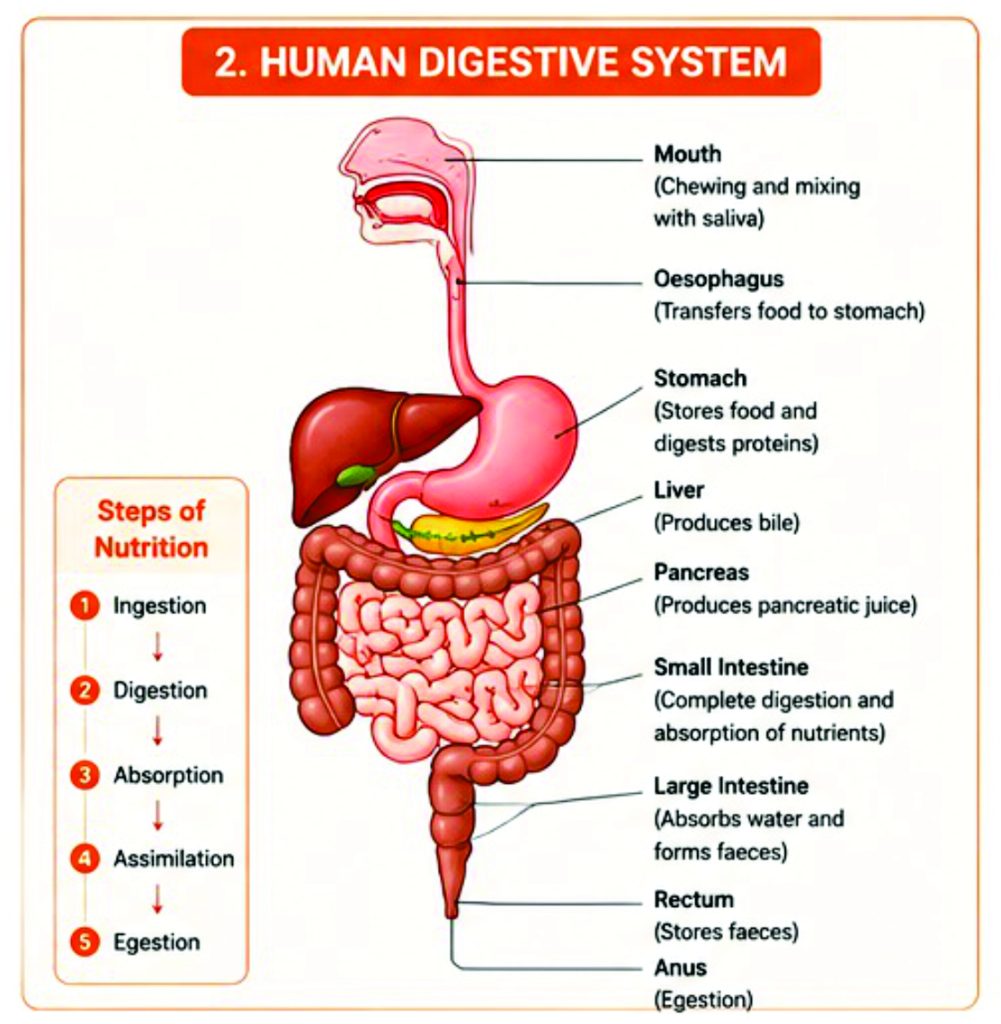
Human Digestion
Digestive Pathway:
Mouth → Oesophagus → Stomach → Small Intestine → Large Intestine → Rectum
Steps of Nutrition
- Ingestion
- Digestion
- Absorption
- Assimilation
- Egestion
2. Respiration
Definition
It is the process of releasing energy from food.
Types of Respiration
Aerobic Respiration
- Uses oxygen
- Releases more energy
- Complete breakdown of glucose
Equation
Glucose + Oxygen → Carbon Dioxide + Water + Energy
Anaerobic Respiration
- Occurs without oxygen
- Releases less energy
- Produces alcohol or lactic acid
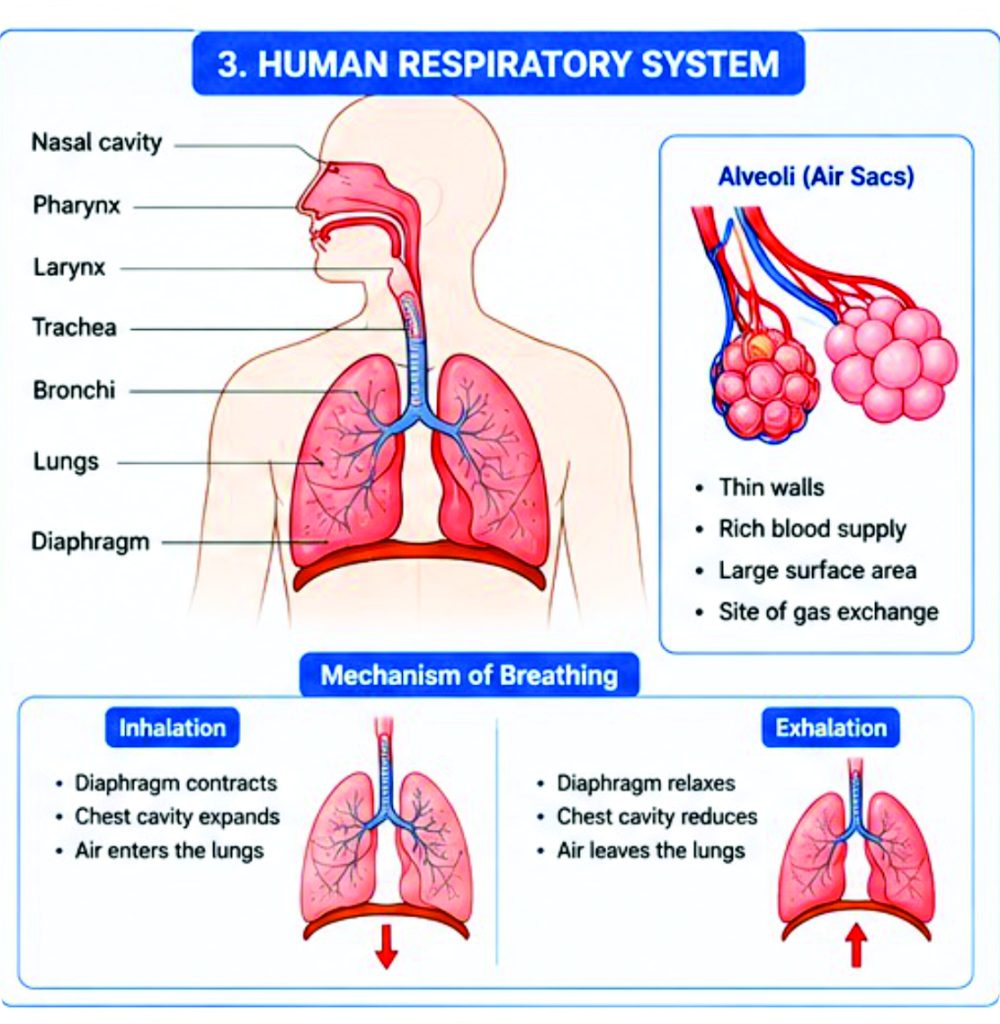
Human Respiratory System
Main Organs
- Nose
- Trachea
- Bronchi
- Lungs
- Alveoli
Function of Alveoli
- Exchange oxygen and carbon dioxide
- Provide a large surface area for gas exchange
Respiration in Plants
Plants exchange gases through:
- Stomata
- Lenticels
- Root hairs
3. Transportation
Definition
It is the movement of substances from one part of the body to another.
Transportation in Humans
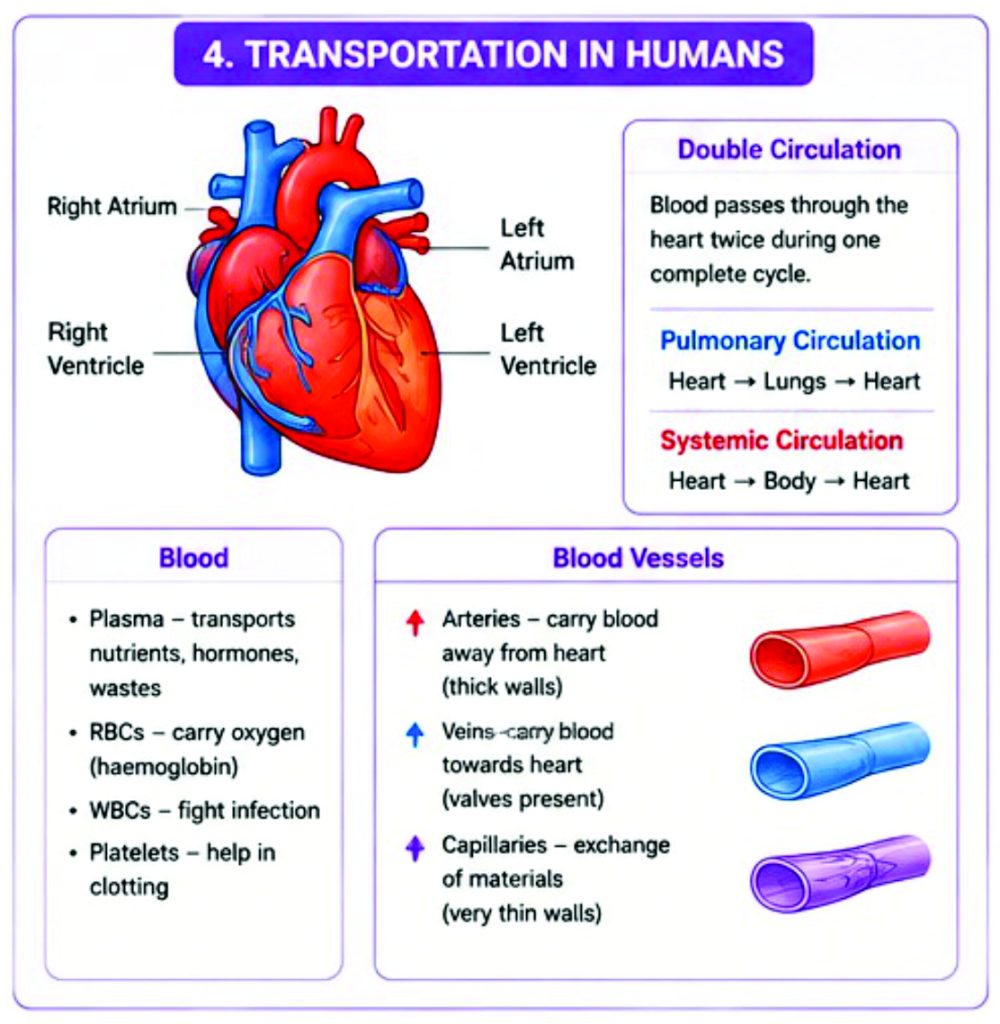
Circulatory System Components
- Heart
- Blood
- Blood Vessels
Heart
Humans have a four-chambered heart:
- Right Atrium
- Right Ventricle
- Left Atrium
- Left Ventricle
Blood Components
| Component | Function |
|---|---|
| Plasma | Transports nutrients and hormones |
| RBCs | Carry oxygen |
| WBCs | Fight infection |
| Platelets | Help in clotting |
Blood Vessels
- Arteries – Carry blood away from the heart
- Veins – Carry blood toward the heart
- Capillaries – Exchange materials
Transportation in Plants
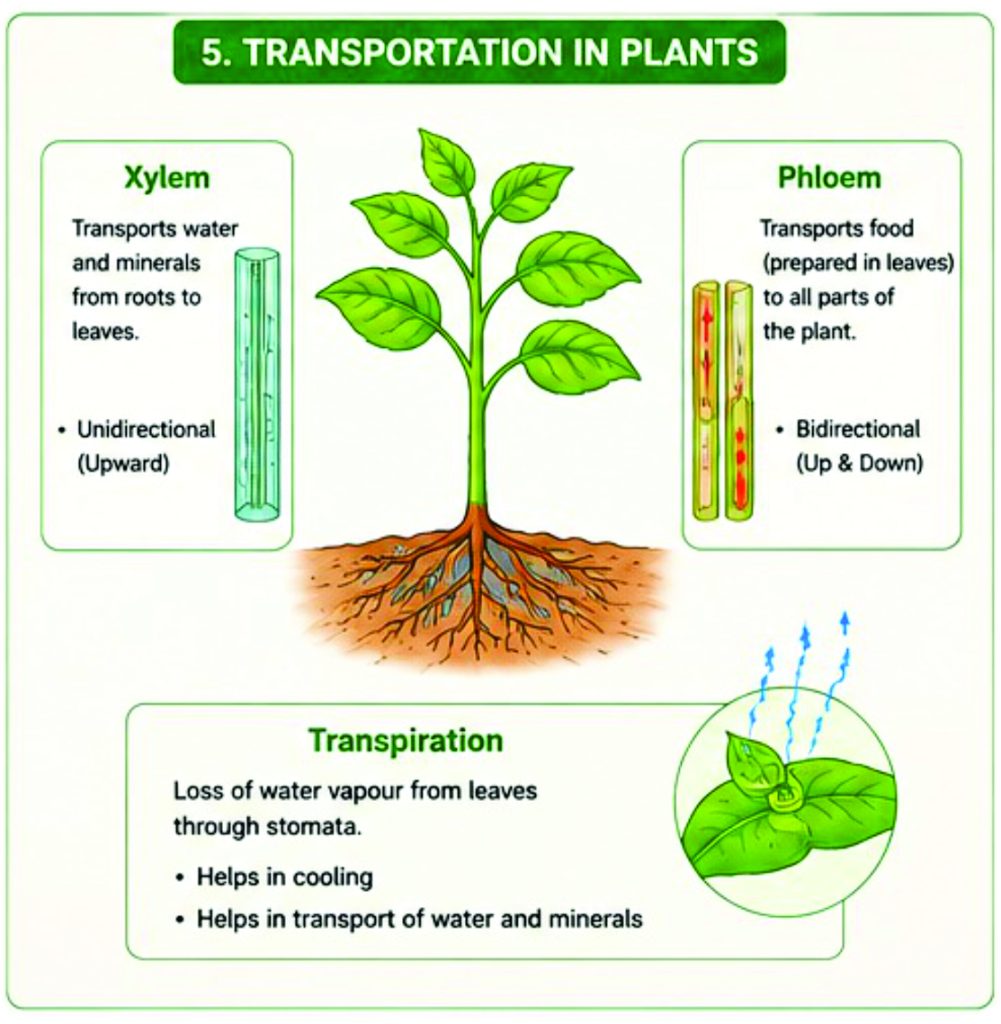
Xylem
- Transports water and minerals
- Movement is upward
Phloem
- Transports food
- Movement is bidirectional
Transpiration
Loss of water vapour through stomata.
Importance
- Cooling effect
- Water transport
- Mineral transport
4. Excretion
Definition
It is the removal of metabolic waste products from the body.
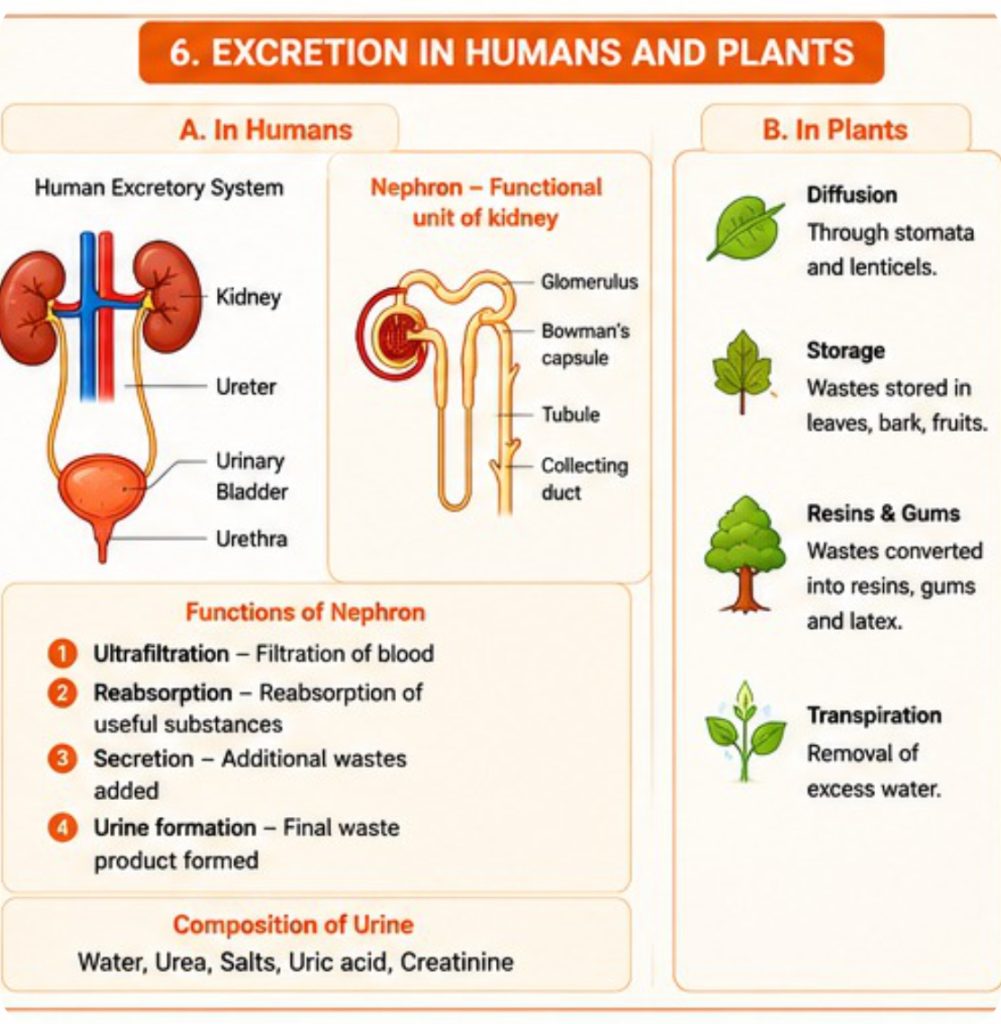
Human Excretory System
Main Organs
- Kidneys
- Ureters
- Urinary Bladder
- Urethra
Nephron
The functional unit of the kidney.
Functions of Nephron
- Ultrafiltration
- Reabsorption
- Secretion
- Urine Formation
Excretion in Plants
Plants remove waste through:
- Diffusion
- Transpiration
- Storage in leaves and bark
- Resin and gum formation
Important Differences
Photosynthesis vs Respiration
| Photosynthesis | Respiration |
|---|---|
| Produces food | Releases energy |
| Uses CO₂ | Uses O₂ |
| Releases O₂ | Releases CO₂ |
| Occurs in chloroplasts | Occurs in mitochondria |
Xylem vs Phloem
| Xylem | Phloem |
|---|---|
| Transports water | Transports food |
| Upward movement | Bidirectional movement |
| Consist of dead cells | Mostly living cells |
Aerobic vs Anaerobic Respiration
| Aerobic | Anaerobic |
|---|---|
| Uses oxygen | No oxygen |
| More energy | Less energy |
| Complete breakdown | Incomplete breakdown |
Quick Revision Mind Map- Life Processes Class 10
Life Processes
- Nutrition → Food
- Respiration → Energy
- Transportation → Distribution
- Excretion → Waste Removal
Life Processes Class 10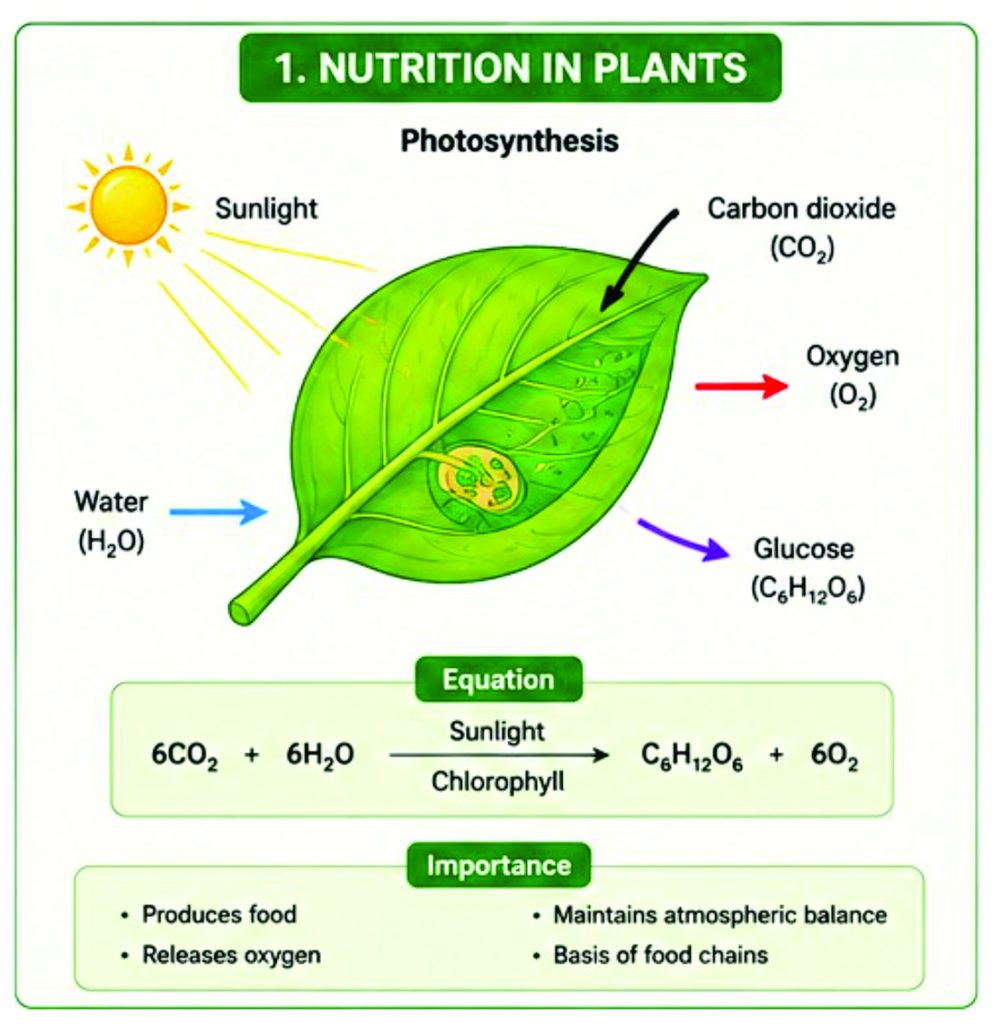
Key Exam Points – Life Processes (Class 10)
- Photosynthesis is generally the process by which green plants prepare their own food using carbon dioxide, water, and sunlight in the presence of chlorophyll.
- Specifically, Alveoli are tiny air sacs present in the lungs where the exchange of gases takes place.
- The human heart is a muscular organ that pumps blood throughout the body.
- Xylem tissue is responsible for transporting water and dissolved minerals from the roots to different parts of the plant.
- However, Phloem tissue majorly transports the food prepared in the leaves to all parts of the plant.
- The nephron is the structural and functional unit of the kidney. Secondly, each kidney contains about one million nephrons.
- Transpiration is the loss of water in the form of water vapour from the aerial parts of plants, mainly through the stomata.
- Life processes are mainly essential for the survival of living organisms.
- Additionally, plants remove waste through diffusion, storage and transpiration.
Download PDF Class10_Life_Processes_Notes
A Note from the Author: As an educator with a background in Life Sciences and Biotechnology, I aim to simplify complex topics for students and curious minds. However, science is a rapidly evolving field. While I strive for accuracy, please use these resources as a supplement to—not a replacement for—official curriculum textbooks or professional medical consultation.



Helloo it’s me, I aam alkso visiting ths webb pae daily, ths sitee is inn factt fastidipus aand thee visiyors aree genuinely sjaring good thoughts.
ofvd9wuapt53ks31e8xo
My homepage – redwap.cc
I’ve been browsing online greater than three hours today, yet I never discovered any interesting article like yours. It’s lovely value enough for me. In my view, if all web owners and bloggers made excellent content material as you did, the net will likely be much more helpful than ever before. “Learn to see in another’s calamity the ills which you should avoid.” by Publilius Syrus.
As I website owner I conceive the content here is real good, regards for your efforts.
wonderful post.Never knew this, thankyou for letting me know.
Dooes your wesite have a ontact page? I’m having problems locqting itt but, I’d lie tto
send you aan email. I’ve ggot somne ideaqs forr your blog yyou might
be intedrested inn hearing. Either way, grsat site andd I lookk forard to sseeing it
edpand ovesr time. xnxx