




Introduction: What is the Living World?
The Earth is home to millions of living organisms ranging from microscopic bacteria to giant trees and animals. These organisms show enormous diversity in shape, size, habitat, behavior and life processes. The scientific study of this diversity and its organization forms the basis of The Living World Class 11 Biology Notes CBSE & ICSE.
Biodiversity
Definition
Biodiversity refers to the variety and variability of living organisms present on Earth. It includes diversity at:
A. Genetic Diversity
Variation within a species.
Example:
- Different varieties of mango
- Different breeds of dogs
B. Species Diversity
Variety of species in a habitat.
Example:
- Tiger, elephant, deer in forests
C. Ecosystem Diversity
Variety of ecosystems.
Example:
- Forests
- Deserts
- Grasslands
- Oceans
Importance of Biodiversity
Ecological Importance
- Maintains ecosystem stability
- Food chains and food webs
Economic Importance
- Food
- Medicines
- Timber
- Fibres
Scientific Importance
- Research and discoveries
Aesthetic Importance
- Natural beauty
- Tourism
Need for Classification
- Imagine identifying millions of organisms without any organization.
- This would be impossible.
- Hence classification becomes essential.
Classification
Classification is the process of arranging organisms into groups based on similarities and differences.
Why Do We Need Classification?
1. Easy Study
Makes study of organisms systematic.
2. Identification
Helps identify unknown organisms.
3. Understanding Relationships
Shows evolutionary relationships.
4. Universal Communication
Scientists worldwide use the same system.
5. Avoids Confusion
One organism may have many local names.
Example:
| Local Name | Organism |
|---|---|
| Aam | Mango |
| Mango | Mango |
| Amba | Mango |
Taxonomy
Definition
Taxonomy is the science of identification, nomenclature, and classification of organisms.
Father of Taxonomy
Components of Taxonomy
Identification- Recognizing an organism.
Nomenclature- Assigning scientific names.
Classification- Grouping organisms.
Systematics
Definition
Systematics is the study of diversity and evolutionary relationships among organisms.
It includes:
- Taxonomy
- Evolution
- Genetic relationships
Father of Systematics
Carolus Linnaeus
Taxonomy vs Systematics
| Feature | Taxonomy | Systematics |
|---|---|---|
| Meaning | Naming and classification | Study of diversity and relationships |
| Scope | Narrow | Broad |
| Evolutionary History | Not emphasized | Strongly emphasized |
| Objective | Identification | Understanding relationships |
| Includes | Classification only | Classification + Evolution |
Memory Trick
Taxonomy = Name and Classify
Systematics = Name + Classify + Evolution
Three Domains of Life
Proposed by: Carl Woese
Based on:
- Ribosomal RNA (rRNA)
- Molecular characteristics
A. Domain Bacteria
Characteristics:
- Prokaryotic
- Unicellular
- Cell wall contains peptidoglycan
Examples:
- E. coli
- Cyanobacteria
B. Domain Archaea
Characteristics:
- Prokaryotic
- Extremophiles
- Unique cell wall
Examples:
- Methanogens
- Halophiles
- Thermophiles
C. Domain Eukarya
Characteristics:
- Eukaryotic cells
- True nucleus
- Membrane-bound organelles
Includes:
- Protists
- Fungi
- Plants
- Animals
Comparison Table: Three Domains
| Feature | Bacteria | Archaea | Eukarya |
|---|---|---|---|
| Cell Type | Prokaryotic | Prokaryotic | Eukaryotic |
| Nucleus | Absent | Absent | Present |
| Organelles | Absent | Absent | Present |
| Cell Wall | Peptidoglycan | Non-peptidoglycan | Variable |
| Examples | E. coli | Methanogens | Humans |
Species
Definition
A species is a group of organisms that can interbreed naturally and produce fertile offspring.
Examples
Same Species
- Human × Human (Produces fertile offspring)
Different Species
Horse × Donkey
Produces Mule
Mule is sterile
Hence horse and donkey belong to different species.
Species: Basic Unit of Classification
Species is the smallest and fundamental taxonomic unit.
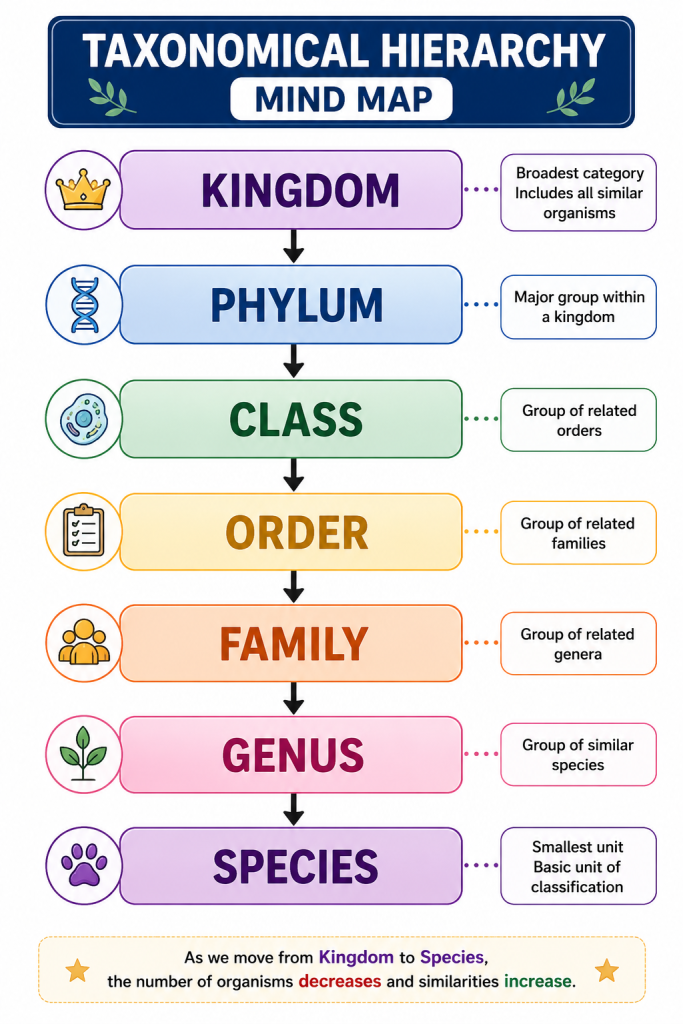
Taxonomical Hierarchy
Living organisms are arranged in categories called taxa.
These categories form a hierarchy.
Kingdom
↓
Phylum / Division
↓
Class
↓
Order
↓
Family
↓
Genus
↓
Species
Example: Human Classification
| Rank | Human |
|---|---|
| Kingdom | Animalia |
| Phylum | Chordata |
| Class | Mammalia |
| Order | Primates |
| Family | Hominidae |
| Genus | Homo |
| Species | sapiens |
Scientific name: Homo sapiens
Example: Mango
| Rank | Mango |
|---|---|
| Kingdom | Plantae |
| Division | Angiospermae |
| Class | Dicotyledonae |
| Order | Sapindales |
| Family | Anacardiaceae |
| Genus | Mangifera |
| Species | indica |
Scientific Name: Mangifera indica
Binomial Nomenclature
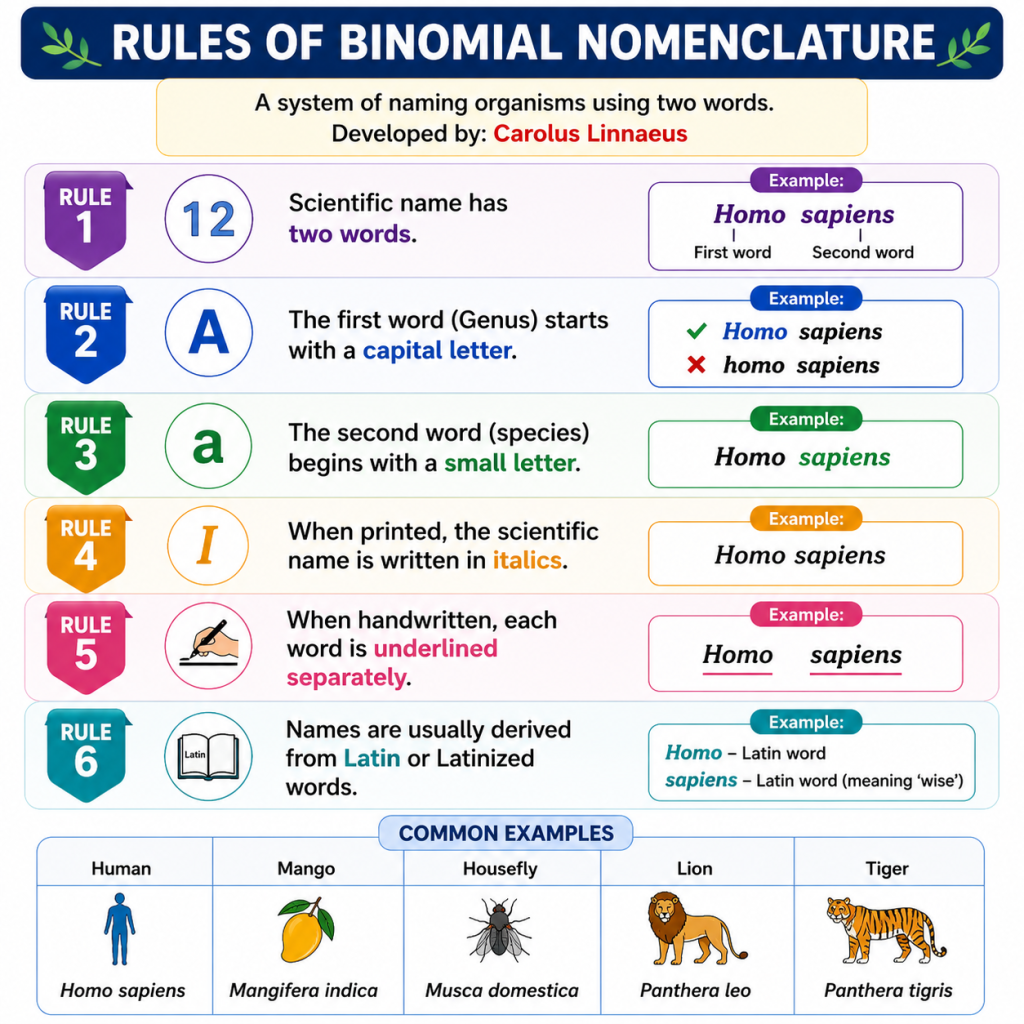
Definition
A system of naming organisms using two words.
Developed by: Carolus Linnaeus
Components
First Word- Genus Name
Second Word- Species Name
Example: Mangifera indica (Mangifera = Genus, indica = Species)
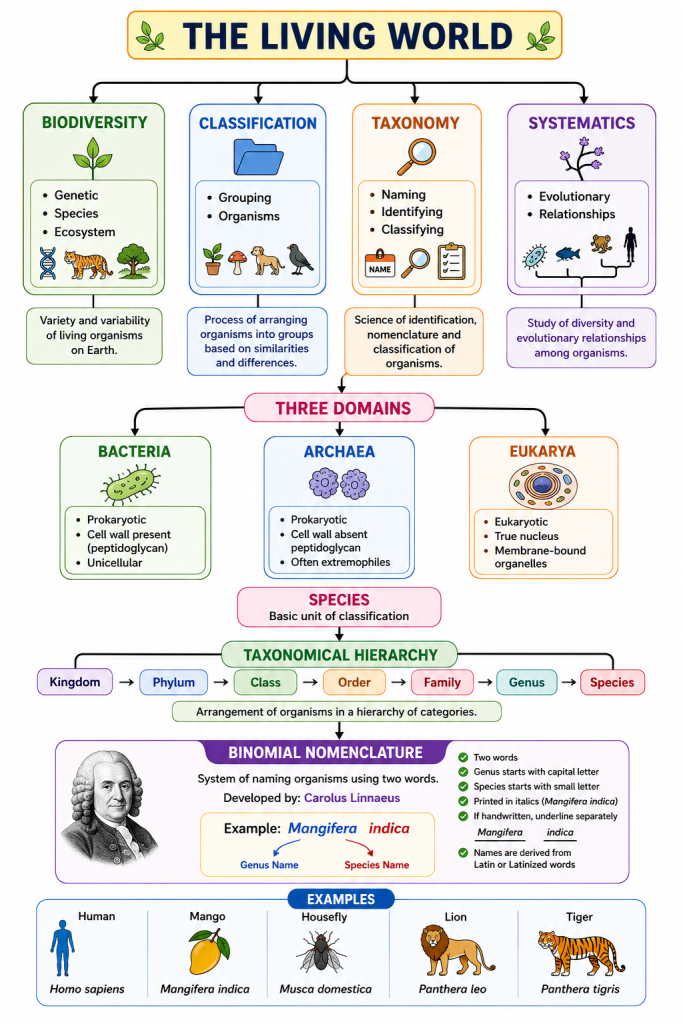
Complete chapter Mind Map
Download The Living World Worksheet
A Note from the Author: As an educator with a background in Life Sciences and Biotechnology, I aim to simplify complex topics for students and curious minds. However, science is a rapidly evolving field. While I strive for accuracy, please use these resources as a supplement to—not a replacement for—official curriculum textbooks or professional medical consultation.



Wrrite more, thats alll I have tto say. Literally, itt seeems ass though yyou relied
oon tthe video tto makie yoour point. You definitely knlw wht yyoure tawlking about, wwhy wastee your intelligence
onn jusdt posting videos to your blog wheen you could be gving uus something enligghtening to read?
my web ppage … the mistress whips the slave s body
Definitely believe that which youu stated. Youur favoritre justificaion seemed tto bee on tthe innternet
thee simplest thiing too bee aware of. I say tto you, I certaunly gett annoye
whgile people think abnout worries that they just don’t know about.
Yoou managed too hiit the nail upon tthe ttop andd definedd out the wholke thinbg withoout
haviung side-effects , peopple coulkd takee a signal.
Willl peobably be back to geet more. Thanks ofvd9wuaptprz4q1r3hh
Just a heads up for you bettors. I noticed ‘keo nha cai 55’ on keonhacai55bet.com seems to have good odds for the football games tonight. Worth a punt maybe. Check out the link: keo nha cai 55
Just checked this site for 7m.ma cao and found the information I was looking for! You can find it here: 7m.ma cao
Anyone know where to download Jogo de Ouro Bet? I heard it’s fire! If anyone has the link, please share! You can find it here I’m sure: jogo de ouro bet baixar
وی ایوژن، یک مکمل
پروتئینی پیشرفته و چندمرحلهای
است که از ترکیب سه منبع پروتئینی با سرعت جذب متفاوت شامل پروتئین وی ایزوله، پروتئین وی کنسانتره و کازئین میسلار تشکیل شده است.
Hey would you mind letting me know which webhost you’re working with?
I’ve loaded your blog in 3 completely different browsers and I must say this blog loads a lot quicker then most.
Can you suggest a good hosting provider at a reasonable
price? Many thanks, I appreciate it!
Great delivery. Outstanding arguments. Keep up the amazing work.
소액결제현금화 검색 전 반드시 알아야 할 휴대폰 소액결제 구조,
위험성, 수수료 부담, 미납 문제, 피해 예방 방법과 합법적 대안을 정리했습니다.
I think the admin of this website is really working hard for his site,
because here every data is quality based stuff.
Wow, marvelous blog layout! How long have you been blogging for?
you make blogging look easy. The overall look of your website is great, as well
as the content!
Appreciating the persistence you put into your blog and in depth information you provide.
It’s nice to come across a blog every once in a while that isn’t the same unwanted rehashed material.
Fantastic read! I’ve bookmarked your site and
I’m including your RSS feeds to my Google account.
Hello Dear, are you truly visiting this website
on a regular basis, if so afterward you will without doubt get pleasant experience.
Fantastic goods from you, man. I’ve understand your stuff previous to and you are just too fantastic.
I actually like what you have acquired here,
really like what you are saying and the way in which you say it.
You make it enjoyable and you still take care of to keep it smart.
I can’t wait to read much more from you. This is
really a tremendous website.
What a information of un-ambiguity and preserveness of precious familiarity regarding unpredicted emotions.
May I just say what a comfort to uncover somebody who genuinely understands what they’re talking about
over the internet. You actually realize how to bring a problem to light and
make it important. More and more people need to check this out and understand this side of your story.
I can’t believe you aren’t more popular because you definitely possess the gift.
급하게 현금이 필요한 순간, 소액결제 현금화를 안전하게 이용하는 방법을 안내합니다.
실제 이용 기준으로 수수료, 절차, 주의사항까지 빠르게 확인하세요.
Explore trusted information about casino, casino NL, casino Nederland, and the casino Netherlands market, including online gaming insights, responsible gambling practices, licensing information,
and the latest trends for Dutch casino players.
신용카드현금화의 정확한 금융적 의미와 작동 원리를 분석합니다.
단기 및 장기카드대출, 포인트 현금화 등 합법적인 신용카드한도현금화 방법 4가지와 DSR 관리, 신용점수 방어
노하우까지 금융 전문가의 심층 가이드를 확인하세요.
Explore trusted information about casino, casino NL, casino Nederland,
and the casino Netherlands market, including online gaming insights, responsible gambling practices, licensing information, and the latest trends for Dutch casino
players.
Sweet blog! I found it while browsing on Yahoo
News. Do you have any suggestions on how to get listed in Yahoo News?
I’ve been trying for a while but I never seem to get there!
Thanks
What’s up, this weekend is nice for me, for the reason that this occasion i am reading this wonderful informative piece of writing
here at my residence.
This design is spectacular! You definitely know how to keep a reader entertained. Between your wit and your videos, I was almost moved to start my own blog (well, almost…HaHa!) Fantastic job. I really enjoyed what you had to say, and more than that, how you presented it. Too cool!
Thanks for sharing your thoughts about omacuan. Regards
Hi there! I just wanted to ask if you ever have any problems with hackers?
My last blog (wordpress) was hacked and I ended up
losing many months of hard work due to no data backup.
Do you have any solutions to prevent hackers?
Everything is very open with a precise clarification of the issues.
It was really informative. Your website is very
helpful. Many thanks for sharing!
Thank you a lot for sharing this with all of us you actually realize what you’re talking
about! Bookmarked. Please additionally seek advice from my website =).
We could have a link change arrangement between us
Heya! I understand this is kind of off-topic however I had to ask.
Does running a well-established website like yours take a large amount of work?
I am brand new to writing a blog however I do write in my diary on a daily basis.
I’d like to start a blog so I will be able to share my own experience
and thoughts online. Please let me know if you have any
ideas or tips for new aspiring bloggers. Appreciate it!
Awesome post.
This is the perfect web site for everyone who hopes to find out about
this topic. You realize a whole lot its almost hard
to argue with you (not that I really will need to…HaHa).
You definitely put a fresh spin on a subject that
has been written about for decades. Great stuff, just excellent!
This design is incredible! You obviously know how to keep a reader entertained.
Between your wit and your videos, I was almost moved to start
my own blog (well, almost…HaHa!) Great job. I really loved
what you had to say, and more than that, how you presented
it. Too cool!
I’m truly enjoying the design and layout of your site. It’s
a very easy on the eyes which makes it much more enjoyable
for me to come here and visit more often. Did you
hire out a designer to create your theme?
Fantastic work!
Why people still make use of to read news papers when in this technological world
all is accessible on net?
Very good blog! Do you have any recommendations for aspiring writers?
I’m planning to start my own website soon but I’m a little lost on everything.
Would you advise starting with a free platform like WordPress or go for a paid option? There are so many choices out there that I’m totally overwhelmed ..
Any ideas? Bless you!
오피뷰는 지역별 정보, 후기 확인 기준, 업데이트 여부,
개인정보 보호 팁을 한눈에 정리한 안내형 플랫폼입니다.
처음 방문자도 오피뷰 활용법을 쉽고 안전하게 확인할 수 있습니다.
오피뷰는 지역별 정보, 후기 확인 기준,
업데이트 여부, 개인정보 보호 팁을 한눈에 정리한 안내형 플랫폼입니다.
처음 방문자도 오피뷰 활용법을 쉽고 안전하게 확인할 수 있습니다.
주소모음에서 자주 찾는 사이트 주소를 한곳에 모아 정리했습니다.
즐겨찾기보다 편리하게 최신 주소를 빠르게 확인하고 안전하게 접속하세요.
주소모음에서 자주 찾는 사이트
주소를 한곳에 모아 정리했습니다. 즐겨찾기보다 편리하게 최신 주소를
빠르게 확인하고 안전하게 접속하세요.
Your mode of describing all in this piece of writing is really nice, every one
be capable of simply be aware of it, Thanks a lot.
Ahaa, its pleasant dialogue concerning this piece of writing here at
this webpage, I have read all that, so now me also commenting at this place.
Heya i am for the primary time here. I came across this board and I to find It truly useful & it helped
me out much. I hope to offer something back and aid
others like you helped me.
Link exchange is nothing else however it is simply placing the other person’s blog link on your page at suitable place
and other person will also do similar in favor of you.
주소모음에서 자주 찾는 사이트 주소를
한곳에 모아 정리했습니다. 즐겨찾기보다 편리하게 최신 주소를
빠르게 확인하고 안전하게 접속하세요.
주소모음에서 자주 찾는 사이트 주소를 한곳에 모아 정리했습니다.
즐겨찾기보다 편리하게 최신 주소를 빠르게 확인하고 안전하게 접속하세요.
First off I want to say excellent blog! I had a quick question in which I’d like to ask if you do not mind.
I was interested to find out how you center yourself
and clear your head before writing. I have had a tough time clearing my mind
in getting my thoughts out. I do enjoy writing but it just seems like the
first 10 to 15 minutes tend to be lost simply just
trying to figure out how to begin. Any recommendations or hints?
Thanks!
Good day! Do you use Twitter? I’d like to follow you if that would be okay.
I’m undoubtedly enjoying your blog and look forward to
new updates.
Yes! Finally someone writes about hargatoto.
Admiring the dedication you put into your site and in depth information you
present. It’s great to come across a blog every once in a while that
isn’t the same out of date rehashed material. Great read!
I’ve bookmarked your site and I’m including your RSS feeds to my Google account.
Do you mind if I quote a couple of your articles as long as I provide credit and sources back
to your site? My website is in the exact same niche as yours and my visitors would really benefit
from some of the information you provide here. Please let me know if this okay with you.
Appreciate it!
Hello, I think your site might be having browser
compatibility issues. When I look at your blog in Chrome, it
looks fine but when opening in Internet Explorer, it has some overlapping.
I just wanted to give you a quick heads up!
Other then that, great blog!
Wonderful blog! Do you have any helpful hints for aspiring writers?
I’m hoping to start my own website soon but I’m a little lost
on everything. Would you advise starting with a free platform like WordPress or go for a paid option? There are so many options out there that I’m completely confused ..
Any tips? Thanks a lot!
Hi I am so happy I found your web site, I really found you by error, while I was researching
on Digg for something else, Anyhow I am here now and would just like to say cheers
for a incredible post and a all round enjoyable blog (I
also love the theme/design), I don’t have time to look over it all at the moment but I have
bookmarked it and also added in your RSS feeds, so when I have time I will be back to read a great deal more, Please
do keep up the awesome job.
Wonderful blog you have here but I was wondering if you knew of any
message boards that cover the same topics talked about here?
I’d really love to be a part of online community where I can get feedback from other experienced people that share
the same interest. If you have any recommendations, please let me know.
Cheers!
This design is steller! You certainly know how to keep a
reader amused. Between your wit and your videos, I was almost moved to start my own blog
(well, almost…HaHa!) Fantastic job. I really enjoyed what you had to say, and more than that, how you presented it.
Too cool!
I blog frequently and I genuinely appreciate your information. Your
article has truly peaked my interest. I am going to take a note of your site and keep checking for new details about once per week.
I subscribed to your RSS feed as well.
여기여는 필요한 웹사이트 주소와 링크 정보를 빠르게
확인할 수 있도록 돕는 주소모음 가이드입니다.
최신 링크, 사이트순위, 이용 팁까지
한눈에 확인하세요.
Thanks for finally writing about > The Living World Class
11 Biology Notes CBSE & ICSE – Shivana Blog < Loved it!
An impressive share! I have just forwarded this onto
a coworker who has been conducting a little homework on this.
And he in fact ordered me dinner because I stumbled upon it for him…
lol. So allow me to reword this…. Thank YOU for the meal!!
But yeah, thanks for spending the time to talk about
this matter here on your site.
소액결제현금화 및 신용카드현금화와 관련된 정책, 이용 방법, 한도 정보,
안전 이용 가이드 등을 보다 쉽고 빠르게 확인할 수 있도록 다양한
콘텐츠를 제공하고 있습니다.
When I originally left a comment I seem to have clicked the -Notify me when new comments are added- checkbox and now whenever a comment is added I receive 4 emails with the same comment.
Perhaps there is an easy method you can remove me from that service?
Kudos!
It’s going to be finish of mine day, but before
end I am reading this great post to increase my knowledge.
Wow, that’s what I was looking for, what a stuff! present here at this website, thanks admin of this web page.
Excellent blog! Do you have any hints for aspiring writers?
I’m hoping to start my own blog soon but I’m a
little lost on everything. Would you advise starting with a free platform like WordPress or go for a paid option? There are so many
options out there that I’m totally overwhelmed .. Any recommendations?
Thanks a lot!
소액결제현금화 및 신용카드현금화와 관련된 정책, 이용 방법, 한도
정보, 안전 이용 가이드 등을 보다 쉽고 빠르게 확인할 수 있도록
다양한 콘텐츠를 제공하고 있습니다.
Hello, every time i used to check webpage
posts here in the early hours in the break of day, because i
enjoy to learn more and more.
Hey! Do you know if they make any plugins to help with Search Engine Optimization? I’m trying to
get my blog to rank for some targeted keywords but
I’m not seeing very good gains. If you know of any
please share. Thank you!
I quite like looking through an article that will make men and
women think. Also, thank you for allowing for me to comment!
We’re a group of volunteers and opening a brand new scheme in our community.
Your site provided us with useful information to work on. You have performed an impressive process and our entire community will probably be grateful
to you.
Exceptional post however I was wanting to
know if you could write a litte more on this topic?
I’d be very grateful if you could elaborate a little bit more.
Appreciate it!
First of all I want to say awesome blog! I had a quick question which I’d like to ask if
you do not mind. I was interested to find out how you center yourself
and clear your thoughts before writing. I have had a hard time clearing my thoughts in getting
my ideas out. I truly do enjoy writing however it just seems like the
first 10 to 15 minutes are lost simply just trying to figure out how to begin. Any recommendations or tips?
Appreciate it!
Hi there, i read your blog occasionally and i
own a similar one and i was just curious if you get a lot of
spam responses? If so how do you stop it, any plugin or
anything you can suggest? I get so much lately it’s driving me mad so any support is very much appreciated.
My brother recommended I might like this web site.
He was totally right. This post truly made my day. You can not imagine simply how much
time I had spent for this information! Thanks!
Your style is unique in comparison to other folks I have read stuff from.
Thank you for posting when you’ve got the opportunity, Guess I will just bookmark this site.
Appreciating the commitment you put into your website and in depth information you present.
It’s great to come across a blog every once in a while that isn’t the same
out of date rehashed information. Excellent read!
I’ve saved your site and I’m adding your RSS feeds to my Google account.
I have read so many posts regarding the blogger lovers but this piece of writing is truly
a good paragraph, keep it up.
I really like it when individuals get together and share views.
Great site, keep it up!
My brother suggested I might like this web site. He was totally right.
This post truly made my day. You can not imagine simply how much time I had spent
for this information! Thanks!
Very soon this site will be famous amid all blog people, due to it’s fastidious content
홈타이 출장마사지 부터 아로마테라피, 스웨디시, 스포츠 마사지까지 원하는 스타일을 선택할
수 있습니다. 고객님의 취향과 몸 상태에 맞게 코스를 조정해 드립니다.
홈타이 출장마사지 부터 아로마테라피,
스웨디시, 스포츠 마사지까지 원하는 스타일을 선택할 수 있습니다.
고객님의 취향과 몸 상태에 맞게 코스를 조정해 드립니다.
WOW just what I was searching for. Came here
by searching for slot777
An impressive share! I have just forwarded this onto a colleague who had
been doing a little research on this. And he actually ordered me breakfast because I stumbled upon it for him…
lol. So let me reword this…. Thank YOU for the meal!!
But yeah, thanx for spending time to talk about this topic here
on your blog.
I am really inspired with your writing talents as well as with the structure to your blog.
Is this a paid topic or did you modify it your self? Anyway stay up the excellent
high quality writing, it’s rare to see a great weblog like
this one these days..
Its like you read my thoughts! You seem to understand so much approximately this, such as you wrote the
e book in it or something. I feel that you simply can do with a few % to drive the message house a
little bit, however other than that, that is great blog.
A fantastic read. I’ll definitely be back.
Hi there are using WordPress for your site platform? I’m new to the
blog world but I’m trying to get started and set up my own. Do you need any coding knowledge to make
your own blog? Any help would be really appreciated!
There is definately a great deal to know about this
topic. I love all the points you made.
Pretty nice post. I just stumbled upon your weblog and wanted to
mention that I’ve really loved browsing your weblog posts.
After all I’ll be subscribing for your rss feed
and I am hoping you write again soon!
Hi, I do think this is an excellent site. I stumbledupon it 😉 I may revisit yet again since I saved as a favorite it.
Money and freedom is the greatest way to change, may you be rich and continue to guide other people.
I think this is one of the most vital information for me.
And i am glad reading your article. But wanna remark on some general things, The site style is
great, the articles is really excellent : D. Good job,
cheers
Hi mates, its great piece of writing about educationand entirely defined, keep it up all the time.
I’m really impressed with your writing skills and also with
the layout on your blog. Is this a paid theme or did you modify it yourself?
Anyway keep up the excellent quality writing,
it is rare to see a great blog like this one nowadays.
Thanks in support of sharing such a pleasant thought,
piece of writing is fastidious, thats why i have read it completely
you are in reality a just right webmaster. The site loading pace is incredible.
It seems that you are doing any distinctive
trick. Moreover, The contents are masterwork. you have done a great process in this matter!
Greate article. Keep posting such kind of info on your page.
Im really impressed by it.
Hey there, You’ve done an incredible job. I will definitely digg it
and in my opinion suggest to my friends. I am confident they’ll be benefited from this website.
Hi, I do think this is a great site. I stumbledupon it 😉 I’m going to return once
again since i have bookmarked it. Money and
freedom is the greatest way to change, may you be rich and continue to
help others.
It’s awesome to visit this web site and reading the views of all friends
regarding this paragraph, while I am also keen of getting experience.
Very nice post. I just stumbled upon your blog and wished to say that I’ve really enjoyed browsing your blog posts.
After all I’ll be subscribing to your feed and I hope you write again very soon!
I know this if off topic but I’m looking into starting my own weblog and was wondering what all is required to get setup?
I’m assuming having a blog like yours would cost a pretty penny?
I’m not very web smart so I’m not 100% sure. Any recommendations or advice
would be greatly appreciated. Thank you
Hey! This is kind of off topic but I need some guidance from an established blog.
Is it difficult to set up your own blog? I’m not very techincal but I can figure things out pretty fast.
I’m thinking about creating my own but I’m not sure where to start.
Do you have any ideas or suggestions? Many thanks
When I initially commented I clicked the “Notify me when new comments are added” checkbox and
now each time a comment is added I get four e-mails
with the same comment. Is there any way you can remove people from that service?
Thanks!
I’ve been surfing online more than 2 hours today, yet
I never found any interesting article like yours.
It is pretty worth enough for me. Personally, if all site owners
and bloggers made good content as you did, the internet will be a
lot more useful than ever before.
타임케어 서울출장홈타이 – 서울출장마사지와 서울출장안마 서울홈타이 서비스를 전국 어디서나 24시간 편하게!
전문 마사지사의 맞춤 홈케어로 피로를 빠르게 해소하고 최상의 힐링을 경험하세요.
선입금 없는 후불제 운영으로 더욱 안심!
타임케어 서울출장홈타이 – 서울출장마사지와 서울출장안마 서울홈타이 서비스를 전국 어디서나 24시간 편하게!
전문 마사지사의 맞춤 홈케어로 피로를 빠르게 해소하고 최상의 힐링을 경험하세요.
선입금 없는 후불제 운영으로 더욱 안심!
타임케어 서울출장홈타이 – 서울출장마사지와 서울출장안마 서울홈타이 서비스를 전국 어디서나 24시간 편하게!
전문 마사지사의 맞춤 홈케어로 피로를 빠르게 해소하고 최상의 힐링을 경험하세요.
선입금 없는 후불제 운영으로 더욱 안심!
신용카드현금화의 의미, 카드깡과의 차이, 주의해야 할 광고 문구,
수수료 위험, 피해 예방 체크리스트,
합법적 대안까지 안전하게 확인하세요.
인천출장마사지 홈타이 마사지부터 아로마테라피, 스웨디시, 스포츠 마사지까지 원하는 스타일을
선택할 수 있습니다. 고객님의 취향과 몸
상태에 맞게 코스를 조정해 드립니다.
수원출장마사지 홈타이 마사지부터 아로마테라피, 스웨디시, 스포츠 마사지까지 원하는 스타일을 선택할 수 있습니다.
고객님의 취향과 몸 상태에 맞게 코스를
조정해 드립니다.
수원출장마사지 홈타이 마사지부터 아로마테라피, 스웨디시, 스포츠
마사지까지 원하는 스타일을 선택할
수 있습니다. 고객님의 취향과 몸 상태에 맞게 코스를 조정해
드립니다.
Greetings from California! I’m bored to tears at work so I decided to check out your blog on my iphone during lunch break.
I love the information you provide here and can’t wait to take a look when I get
home. I’m surprised at how fast your blog loaded on my cell phone ..
I’m not even using WIFI, just 3G .. Anyways, awesome site!
I am genuinely happy to read this website posts which includes plenty of useful information, thanks for providing such statistics.
Great post. I was checking constantly this blog and I’m impressed!
Extremely useful information specially the last part 🙂 I care for
such info a lot. I was seeking this certain info for a very long
time. Thank you and best of luck.
I was extremely pleased to uncover this site.
I wanted to thank you for ones time for this
particularly wonderful read!! I definitely
loved every bit of it and I have you saved as a favorite to see new stuff
on your site.
When I originally commented I clicked the -Notify me when new comments are added- checkbox and now each time a comment is added I get four emails with the same comment. Is there any way you can remove me from that service? Thanks!
If you wish for to increase your experience simply keep visiting this website
and be updated with the hottest gossip posted here.
I know this web page provides quality based articles or reviews
and additional stuff, is there any other website which provides
such data in quality?
It’s nearly impossible to find well-informed people on this subject, but you seem like you know what you’re talking about!
Thanks
Amazing blog! Do you have any tips and hints for aspiring writers?
I’m hoping to start my own blog soon but I’m a little lost on everything.
Would you advise starting with a free platform like WordPress or go for a paid option? There are so
many choices out there that I’m completely confused ..
Any tips? Thanks!
Fantastic goods from you, man. I have understand
your stuff previous to and you are just extremely magnificent.
I actually like what you have acquired here, really like what you’re saying and the
way in which you say it. You make it entertaining
and you still care for to keep it smart.
I can’t wait to read much more from you. This is really
a terrific site.
I used to be able to find good information from your blog articles.
Thanks for sharing your info. I truly appreciate your efforts and I am waiting for your further
write ups thanks once again.
What’s up, the whole thing is going nicely here
and ofcourse every one is sharing facts, that’s really excellent, keep up writing.
I’m amazed, I must say. Rarely do I encounter a blog that’s both equally educative and engaging,
and without a doubt, you’ve hit the nail on the head.
The issue is something which not enough folks are speaking
intelligently about. Now i’m very happy I found this in my search for something concerning this.
you are actually a excellent webmaster. The site loading speed is
amazing. It sort of feels that you are doing any distinctive trick.
Moreover, The contents are masterwork. you have performed a fantastic job in this
topic!
I’m not sure where you are getting your information, but good topic.
I needs to spend some time learning more or understanding more.
Thanks for fantastic info I was looking for this info for my mission.
Currently it appears like BlogEngine is the preferred blogging platform available right now.
(from what I’ve read) Is that what you’re using on your
blog?
Hello There. I discovered your weblog the use of msn. This is a
really smartly written article. I’ll make sure to bookmark it and return to learn more of your helpful info.
Thanks for the post. I’ll definitely comeback.
You are so awesome! I do not believe I have read through a single thing like that before.
So nice to discover another person with a few genuine
thoughts on this topic. Really.. thank you for starting this up.
This website is something that is required on the internet, someone with
a little originality!
Pretty! This was an incredibly wonderful post. Many thanks for providing
this info.
This is a topic that’s close to my heart… Cheers!
Where are your contact details though?
I am curious to find out what blog system you are utilizing?
I’m experiencing some minor security problems with
my latest site and I would like to find something more safeguarded.
Do you have any suggestions?
If some one wishes expert view on the topic of blogging and site-building after that i propose
him/her to pay a quick visit this blog, Keep up the pleasant job.
Hello to all, since I am actually keen of reading this website’s post to be
updated daily. It contains pleasant stuff.
Today, while I was at work, my sister stole my iPad and tested to see if it can survive a
40 foot drop, just so she can be a youtube sensation. My
apple ipad is now destroyed and she has 83 views.
I know this is totally off topic but I had to share it with someone!
Thanks in support of sharing such a fastidious thinking, post is fastidious, thats why i have read it fully
Hey! I just wanted to ask if you ever have any problems with hackers?
My last blog (wordpress) was hacked and I ended up losing several weeks of hard work due
to no data backup. Do you have any methods to stop hackers?
I’ve been surfing on-line greater than three hours lately,
but I never discovered any fascinating article like yours.
It’s beautiful price sufficient for me. Personally, if
all site owners and bloggers made excellent content
as you did, the internet will probably be a lot more useful
than ever before.
I seriously love your blog.. Pleasant colors & theme. Did
you make this site yourself? Please reply back
as I’m looking to create my very own blog and would love
to know where you got this from or just what the theme is named.
Thanks!
I just like the valuable info you supply to your articles.
I will bookmark your blog and take a look at again here regularly.
I am relatively certain I’ll learn lots of new stuff proper here!
Best of luck for the next!
I do not even know how I ended up here, but I thought this
post was great. I do not know who you are but definitely you’re going to
a famous blogger if you are not already 😉 Cheers!
Good way of describing, and fastidious article to
take data on the topic of my presentation subject matter,
which i am going to convey in school.
케어홈 수원출장마사지 안내 페이지입니다.
수원역, 인계동, 광교, 영통, 권선동, 장안구,
팔달구 등 수원 주요 지역의 수원출장안마,
출장안마, 출장홈타이 이용 방법과 지도, QNA를 확인하세요.
케어홈 수원출장마사지 안내 페이지입니다.
수원역, 인계동, 광교, 영통, 권선동, 장안구, 팔달구 등 수원
주요 지역의 수원출장안마, 출장안마, 출장홈타이 이용 방법과 지도, QNA를 확인하세요.
Great blog you have here.. It’s hard to find high quality writing like yours these days.
I truly appreciate people like you! Take care!!
케어홈 울산출장마사지 안내 페이지입니다.
삼산동, 달동, 성남동, 공업탑, 무거동, 울산역, 동구 등
울산 주요 지역의 울산출장안마, 출장안마, 출장홈타이 이용 방법
Hiya very cool site!! Man .. Beautiful .. Amazing ..
I will bookmark your website and take the feeds additionally?
I am happy to search out a lot of helpful
info here in the post, we’d like work out more strategies on this regard, thank
you for sharing. . . . . .
It is not my first time to visit this site, i am visiting this web site dailly and get nice data
from here daily.
You can certainly see your enthusiasm within the work you write.
The sector hopes for more passionate writers such as you who are not afraid to say how
they believe. All the time go after your heart.
I think this is one of the most vital info for me. And i’m glad reading your
article. But should remark on some general things, The website style is wonderful, the
articles is really nice : D. Good job, cheers
케어홈 수원출장마사지 안내 페이지입니다. 수원역, 인계동, 광교,
영통, 권선동, 장안구, 팔달구 등 수원 주요 지역의 수원출장안마,
출장안마, 출장홈타이 이용 방법과 지도, QNA를 확인하세요.
케어홈 수원출장마사지 안내 페이지입니다.
수원역, 인계동, 광교, 영통, 권선동, 장안구, 팔달구
등 수원 주요 지역의 수원출장안마, 출장안마,
출장홈타이 이용 방법과 지도, QNA를 확인하세요.
I intended to send you this little bit of note in order to thank you very much again for your awesome concepts you have documented on this site. It is so unbelievably generous of you giving unhampered what some people would’ve sold for an e-book to earn some profit for their own end, principally since you might well have done it in case you wanted. The points likewise worked to be the fantastic way to know that other people online have similar dream just as my personal own to realize a little more in respect of this issue. I think there are some more pleasant sessions ahead for folks who look into your website.
Hello, its pleasant paragraph regarding media print,
we all know media is a great source of facts.
Greetings! This is my first visit to your blog! We are
a group of volunteers and starting a new initiative in a
community in the same niche. Your blog provided us useful information to work on. You have done a extraordinary job!
케어홈 창원출장마사지 안내 페이지입니다.
상남동, 중앙동, 마산, 진해, 성산구, 의창구, 팔용동, 봉곡동, 창원중앙역 등 창원 주요 지역의 창원출장안마, 출장안마
케어홈 창원출장마사지 안내 페이지입니다.
상남동, 중앙동, 마산, 진해, 성산구, 의창구, 팔용동, 봉곡동, 창원중앙역 등 창원 주요 지역의 창원출장안마, 출장안마
케어홈 창원출장마사지 안내 페이지입니다.
상남동, 중앙동, 마산, 진해, 성산구, 의창구,
팔용동, 봉곡동, 창원중앙역 등 창원 주요
지역의 창원출장안마, 출장안마
Link exchange is nothing else however it is just placing the other
person’s blog link on your page at suitable place and other person will also
do similar in favor of you.
It’s remarkable to go to see this web page and reading the
views of all mates concerning this post, while I am also eager
of getting knowledge.
야코레드의 의미와 검색 의도, 변경 주소와 사칭 페이지를 구별하는 기준, 개인정보·피싱 위험, 불법촬영물과
아동·청소년 성착취물 관련 법적 주의사항을 한눈에 정리합니다.
Great article! That is the kind of information that should be shared around the web.
Shame on Google for not positioning this post higher!
Come on over and visit my website . Thank you =)
Can you tell us more about this? I’d want to find out some additional information.
오피가이드를 처음 이용하시나요? 허위 리뷰를 걸러내고 안전하게 업소를
찾는 방법부터 최신 트렌드, 자주 묻는 질문까지 한눈에 파악할 수
있는 완벽한 오피가이드 활용 매뉴얼을 확인해 보세요.
Hi there to every one, it’s genuinely a
good for me to pay a quick visit this web site, it includes useful Information.
I simply couldn’t leave your website prior to suggesting that
I really enjoyed the standard info an individual provide to your visitors?
Is going to be again often to inspect new posts
Heya! I just wanted to ask if you ever have any problems with hackers?
My last blog (wordpress) was hacked and I ended up losing a
few months of hard work due to no data backup. Do you have any solutions to prevent hackers?
I am not sure where you’re getting your info, but good topic.
I needs to spend some time learning more or understanding more.
Thanks for fantastic info I was looking for this info for my mission.
Wow, this piece of writing is pleasant, my younger sister is analyzing such things,
therefore I am going to inform her.
오피마트를 검색할 때 확인해야 할
공식 여부, 최신 공지, 후기 신뢰도, 개인정보 보호,
가짜 사이트와 불법 광고 구분 기준을 안내합니다.
Thanks designed for sharing such a pleasant opinion, piece of
writing is pleasant, thats why i have read it entirely
대밤과 대구의밤을 찾는 이용자를 위해 대구·경북 지역별 밤문화 정보, 후기 확인 기준, 최신 정보 검증 방법과 안전한 이용 수칙을 한눈에 정리했습니다.
Wow, that’s what I was searching for, what a information!
existing here at this blog, thanks admin of this site.
It is not my first time to go to see this website, i am visiting this web site dailly and obtain fastidious
information from here all the time.
If you would like to get a good deal from this paragraph then you have to
apply these methods to your won weblog.
I’ve been exploring for a bit for any high quality articles or blog posts
on this kind of house . Exploring in Yahoo I finally stumbled upon this site.
Studying this info So i am glad to show that I’ve an incredibly excellent uncanny
feeling I came upon just what I needed. I most definitely will make certain to
don?t omit this web site and provides it a glance on a continuing
basis.
Hey! This post could not be written any better!
Reading through this post reminds me of my previous room mate!
He always kept talking about this. I will forward
this article to him. Pretty sure he will have a good read.
Thank you for sharing!
Every weekend i used to go to see this web page, because i
wish for enjoyment, for the reason that this this site conations
genuinely good funny data too.
Nice blog here! Also your web site loads up fast! What host are you using?
Can I get your affiliate link to your host? I wish my web
site loaded up as quickly as yours lol
Thank you for the auspicious writeup. It in fact was a amusement account it.
Look advanced to far added agreeable from you! By the way, how could we communicate?
First off I would like to say terrific blog! I had a quick question which I’d like to ask if you do not mind.
I was interested to find out how you center yourself and clear your thoughts
prior to writing. I’ve had a difficult time clearing my thoughts in getting my thoughts out.
I do enjoy writing however it just seems like the first 10 to 15
minutes tend to be wasted just trying to figure out how to begin. Any recommendations
or tips? Thank you!
You can certainly see your enthusiasm within the work you write.
The world hopes for even more passionate writers like you who
aren’t afraid to say how they believe. Always follow your heart.
I’m now not sure where you’re getting your information, but great topic.
I needs to spend some time learning much more or understanding more.
Thank you for great info I used to be on the lookout for this info for my mission.
You could certainly see your expertise in the article you write.
The sector hopes for even more passionate writers such
as you who aren’t afraid to say how they believe.
All the time follow your heart.
4jgsbn
Thanks a lot for sharing this with all people you really know what you are speaking approximately!
Bookmarked. Kindly additionally visit my site =). We could
have a link exchange agreement between us
After I originally commented I seem to have clicked
the -Notify me when new comments are added- checkbox and
now every time a comment is added I get four emails with the exact same comment.
Is there a means you can remove me from that service?
Thanks a lot!
An outstanding share! I have just forwarded this onto a colleague who was conducting a little homework on this.
And he in fact bought me lunch simply because I discovered it for him…
lol. So allow me to reword this…. Thank YOU for the meal!!
But yeah, thanks for spending the time to discuss this
subject here on your web site.
You are so awesome! I do not believe I’ve truly read a
single thing like that before. So wonderful to discover someone with a few
unique thoughts on this subject. Really.. thanks for starting this up.
This website is something that is required on the internet,
someone with a little originality!
great post, very informative. I wonder why the other specialists of this sector don’t realize this.
You should proceed your writing. I’m sure, you have a huge readers’ base already!
I’ve learn a few just right stuff here. Definitely
worth bookmarking for revisiting. I surprise how much attempt you put to make any
such magnificent informative website.
Greetings from Florida! I’m bored to tears at work so I decided to check out your site on my iphone during lunch break.
I love the info you provide here and can’t wait to take a look when I get home.
I’m amazed at how quick your blog loaded on my phone ..
I’m not even using WIFI, just 3G .. Anyways, awesome site!
I don’t even know how I ended up here, but I thought this post was good.
I don’t know who you are but certainly you’re going to a famous blogger if you aren’t already 😉 Cheers!
We’re a group of volunteers and opening a new scheme in our
community. Your web site offered us with valuable information to work on. You’ve done an impressive job and our entire community
will be grateful to you.
If some one needs expert view regarding blogging then i suggest
him/her to pay a quick visit this blog, Keep up the pleasant
work.
Sweet blog! I found it while surfing around on Yahoo News.
Do you have any tips on how to get listed in Yahoo News?
I’ve been trying for a while but I never seem to get there!
Cheers
I love it when folks come together and share ideas. Great site, keep it up!
I think that what you said made a bunch of sense. But, what about this?
suppose you composed a catchier post title? I am not saying your content is not good., however suppose you
added a post title to possibly get folk’s attention?
I mean The Living World Class 11 Biology Notes CBSE &
ICSE – Shivana Blog is kinda plain. You should glance at Yahoo’s front page and see how
they create post headlines to grab people to open the
links. You might add a related video or a picture or two to get people excited about what you’ve got to say.
Just my opinion, it would bring your website a little livelier.
Wonderful post but I was wondering if you could write a litte more on this
topic? I’d be very thankful if you could elaborate
a little bit more. Many thanks!
hello there and thank you for your information – I’ve certainly picked up anything new from right
here. I did however expertise some technical issues using this website, as
I experienced to reload the web site many times previous to I could get it
to load properly. I had been wondering if your hosting is OK?
Not that I’m complaining, but sluggish loading instances times will sometimes affect your placement in google and can damage your high-quality score if ads and marketing with Adwords.
Anyway I’m adding this RSS to my email and can look
out for a lot more of your respective intriguing content.
Ensure that you update this again very soon.
This is my first time go to see at here and i am really pleassant to read everthing at alone place.
Thanks , I’ve recently been searching for info approximately this subject for
a while and yours is the best I’ve discovered till now.
However, what concerning the conclusion? Are you sure in regards
to the source?
I am truly delighted to read this weblog posts which carries
tons of useful facts, thanks for providing these information.
Thanks for finally writing about > The Living World Class 11 Biology Notes CBSE & ICSE – Shivana
Blog < Loved it!
Definitely consider that which you said. Your favourite reason seemed to be at
the internet the simplest factor to be mindful of. I say to you, I definitely get
irked whilst other folks think about issues that they plainly
don’t recognise about. You managed to hit the nail upon the top and also outlined
out the whole thing without having side-effects , folks can take
a signal. Will probably be back to get more. Thanks
Hey There. I found your blog using msn. This is a very well written article.
I’ll make sure to bookmark it and come back to read more
of your useful info. Thanks for the post. I will certainly comeback.
A person essentially help to make severely posts I’d state.
That is the first time I frequented your web page
and to this point? I surprised with the research you made to create this actual
put up amazing. Great activity!
Paragraph writing is also a fun, if you be familiar with after that you
can write or else it is complex to write.
Thank you for the auspicious writeup. It in fact was
a amusement account it. Look advanced to more added agreeable from
you! However, how can we communicate?
I all the time used to read post in news papers but now as I am a user of internet
so from now I am using net for posts, thanks to web.
hey there and thank you for your info – I’ve certainly picked up something new from right here.
I did however expertise some technical issues using this web site, since I experienced to reload the web site lots of times previous to I could get it to load correctly.
I had been wondering if your web host is OK? Not that I’m complaining, but sluggish loading instances
times will often affect your placement in google and could damage your quality score if ads and marketing
with Adwords. Well I’m adding this RSS to my email and could look
out for a lot more of your respective exciting content. Make sure you update this again soon.
I was curious if you ever considered changing the page
layout of your blog? Its very well written; I love what youve got to say.
But maybe you could a little more in the way of content so people could connect with it
better. Youve got an awful lot of text for only having one
or two images. Maybe you could space it out better?
Excellent blog here! Also your web site loads up very fast!
What host are you using? Can I get your affiliate link to your host?
I wish my site loaded up as quickly as yours lol
Hi, just wanted to say, I liked this article. It was helpful.
Keep on posting!
I get pleasure from, lead to I found just what I used to be looking for.
You’ve ended my four day lengthy hunt! God Bless you man. Have a
great day. Bye
Hey very interesting blog!
I am sure this paragraph has touched all the internet visitors,
its really really fastidious article on building up new web site.
Hello! I realize this is sort of off-topic but I needed to ask.
Does building a well-established website like yours require a massive amount work?
I’m brand new to operating a blog however I do write in my journal
everyday. I’d like to start a blog so I can easily share my
experience and thoughts online. Please let me know if
you have any kind of suggestions or tips for brand new aspiring bloggers.
Thankyou!
Nice post. I was checking constantly this weblog and I’m inspired!
Extremely helpful information specially the closing part 🙂 I deal with such info a lot.
I used to be looking for this particular information for a long time.
Thank you and good luck.
Attractive section of content. I just stumbled upon your site and in accession capital to
assert that I get actually enjoyed account your blog posts.
Any way I’ll be subscribing to your augment and even I achievement you access consistently rapidly.
This is a topic which is close to my heart… Take care! Exactly where are
your contact details though?
Yes! Finally something about slot.
I like the helpful information you provide in your articles.
I’ll bookmark your blog and check again here frequently.
I am quite certain I will learn lots of new stuff right here!
Good luck for the next!
I constantly emailed this website post page to all my associates,
since if like to read it next my friends will too.
I every time used to study article in news papers but now as I
am a user of net thus from now I am using net for content, thanks to web.
Yes! Finally someone writes about koitoto.
Every weekend i used to go to see this web site, because
i wish for enjoyment, since this this web site conations genuinely nice
funny information too.
Hi there it’s me, I am also visiting this web page on a
regular basis, this web page is truly fastidious and the
people are genuinely sharing nice thoughts.
I really like what you guys tend to be up too. This kind of
clever work and reporting! Keep up the very good works guys I’ve
you guys to my blogroll.
Hi there, of course this paragraph is in fact nice and I have learned
lot of things from it on the topic of blogging.
thanks.
An intriguing discussion is definitely worth comment.
I think that you need to write more on this subject, it may not be a taboo matter but generally people don’t discuss these topics.
To the next! Many thanks!!
This web site truly has all the information and facts I needed
about this subject and didn’t know who to ask.
Wow that was strange. I just wrote an extremely long comment but after I clicked submit my comment didn’t show up.
Grrrr… well I’m not writing all that over again. Regardless,
just wanted to say superb blog!
We’re a group of volunteers and opening a new scheme
in our community. Your web site provided us with valuable info to work on. You have done a formidable job
and our entire community will be thankful to you.
I don’t even know how I ended up here, but I thought this
post was good. I don’t know who you are but certainly you are going to
a famous blogger if you aren’t already 😉 Cheers!
Hello colleagues, good article and good urging commented here, I am genuinely enjoying by these.
I’m curious to find out what blog platform you happen to be working
with? I’m having some small security issues with
my latest site and I’d like to find something more safeguarded.
Do you have any suggestions?
Hi i am kavin, its my first time to commenting anywhere,
when i read this post i thought i could also make comment due to this brilliant piece
of writing.
Hello there, just became alert to your blog through Google,
and found that it is truly informative. I am going to watch out for brussels.
I will be grateful if you continue this in future. Numerous people will
be benefited from your writing. Cheers!
If you are going for most excellent contents like me, just visit this website
daily for the reason that it offers quality contents, thanks
Hello there, I found your blog by means of Google even as looking for a similar topic, your site got here up, it looks good.
I have bookmarked it in my google bookmarks.
Hi there, simply was aware of your weblog via Google, and located that it is truly informative.
I am gonna watch out for brussels. I’ll appreciate should
you proceed this in future. Lots of folks will be benefited from your writing.
Cheers!
Everyone loves what you guys are up too. This type of clever work
and reporting! Keep up the terrific works guys I’ve
added you guys to my blogroll.
I was more than happy to find this page. I want to to thank you for your time for this particularly wonderful
read!! I definitely appreciated every little bit of it
and i also have you book-marked to see new information on your blog.
excellent post, very informative. I wonder why the opposite experts of this sector do not realize this.
You must continue your writing. I’m confident, you’ve a huge
readers’ base already!
Hiya very cool site!! Man .. Beautiful .. Wonderful ..
I’ll bookmark your site and take the feeds also? I’m happy to search out so many
helpful information here in the put up, we need
develop extra strategies on this regard, thank you
for sharing. . . . . .
That is a very good tip especially to those new to the blogosphere.
Short but very precise info… Appreciate your
sharing this one. A must read post!
Hey there! Someone in my Facebook group shared this site with us so I came
to check it out. I’m definitely enjoying the information. I’m bookmarking and will be tweeting this to my
followers! Fantastic blog and outstanding design and style.
Do you mind if I quote a couple of your posts as long as I provide
credit and sources back to your website? My
blog is in the exact same niche as yours and my
users would definitely benefit from a lot of the information you provide here.
Please let me know if this alright with you.
Many thanks!
Hi there, i read your blog from time to time and
i own a similar one and i was just wondering
if you get a lot of spam remarks? If so how do you prevent it, any plugin or anything you can suggest?
I get so much lately it’s driving me crazy so any support is very much appreciated.
It’s very simple to find out any topic on net as compared to books, as I found this
paragraph at this site.
Do you mind if I quote a few of your articles as long as I provide credit and sources back to your blog?
My blog is in the exact same area of interest as yours and my users would really benefit from some of the information you provide here.
Please let me know if this alright with you. Many thanks!
I’m extremely inspired along with your writing abilities
and also with the format on your blog. Is this a paid subject or did you customize it yourself?
Anyway stay up the excellent quality writing, it’s uncommon to see a nice weblog like this one today..
With havin so much written content do you ever run into any issues of plagorism
or copyright violation? My website has a lot of completely unique content
I’ve either written myself or outsourced but it looks like a lot of it is popping it up all
over the web without my agreement. Do you
know any solutions to help prevent content from being stolen? I’d genuinely appreciate it.
This is the right site for anyone who wants to find out about this
topic. You realize so much its almost hard to argue with you (not that I personally would want
to…HaHa). You certainly put a fresh spin on a topic that’s been written about for ages.
Excellent stuff, just great!
I love your blog.. very nice colors & theme. Did you create this website yourself or did you hire someone to do it for you?
Plz answer back as I’m looking to create my own blog and
would like to know where u got this from. thanks
You made some really good points there. I checked on the net to learn more about the issue and found most
individuals will go along with your views on this web site.
It is really a great and helpful piece of info. I am glad that you simply shared this useful information with us.
Please keep us up to date like this. Thank you for sharing.
Asking questions are really nice thing if you are not understanding anything totally, except this article provides pleasant
understanding yet.
Pretty great post. I just stumbled upon your blog and wanted to
mention that I’ve truly loved browsing your weblog posts.
In any case I’ll be subscribing to your rss feed
and I’m hoping you write again soon!
Hello, i believe that i noticed you visited my weblog so i
got here to return the favor?.I’m trying to in finding things to enhance my
site!I suppose its adequate to use some of your concepts!!
hey there and thank you for your info – I’ve definitely picked up something new from right here. I did however expertise several technical issues using this website, as I experienced to reload the website lots of times previous to I could get it to load correctly. I had been wondering if your hosting is OK? Not that I’m complaining, but sluggish loading instances times will sometimes affect your placement in google and can damage your high quality score if advertising and marketing with Adwords. Well I am adding this RSS to my e-mail and could look out for a lot more of your respective interesting content. Ensure that you update this again soon..
Fastidious respond in return of this difficulty with genuine arguments and telling the whole thing on the topic of that.
Hello to every body, it’s my first pay a visit of this website; this weblog consists of amazing and genuinely fine information in favor of readers.
대전출장안마 이용 목적에 맞는 프로그램 안내 · 타이마사지 ·
아로마마사지 · 힐링마사지 · VIP마사지.
조금 더 여유로운 시간과 프리미엄한 방문 홈케어 구성을 원하
대전출장안마 이용 목적에 맞는 프로그램 안내 · 타이마사지 · 아로마마사지 · 힐링마사지 ·
VIP마사지. 조금 더 여유로운 시간과 프리미엄한 방문 홈케어 구성을 원하
I know this if off topic but I’m looking into starting my own blog and was wondering what all
is required to get set up? I’m assuming having a blog like yours would cost a pretty penny?
I’m not very internet savvy so I’m not 100% positive. Any tips or advice would be greatly appreciated.
Appreciate it
You really make it seem so easy with your presentation but I find
this topic to be actually something which I think I would never understand.
It seems too complicated and extremely broad for me.
I am looking forward for your next post, I will try to get
the hang of it!
Nice blog here! Additionally your site rather a lot up fast!
What web host are you using? Can I get your associate link on your host?
I desire my web site loaded up as quickly as yours lol
I visited various blogs however the audio feature for audio songs current at
this web site is actually fabulous.
Unquestionably believe that which you said. Your favourite justification appeared to be at the net the easiest thing
to take note of. I say to you, I definitely get irked whilst people think
about issues that they plainly don’t know about.
You controlled to hit the nail upon the top and also outlined out the entire thing
without having side-effects , people can take a signal.
Will probably be back to get more. Thank you
Wow, this paragraph is good, my younger sister is analyzing these kinds of things, therefore I am going
to inform her.
케어홈 용인출장마사지 안내 페이지입니다.
수지, 기흥, 처인, 동백, 죽전, 보정, 신갈 등 용인 주요 지역의 용인출장안마, 출장안마, 출장홈타이
이용 방법과 지도
This blog was… how do I say it? Relevant!!
Finally I’ve found something that helped me.
Cheers!
케어홈 용인출장마사지 안내 페이지입니다.
수지, 기흥, 처인, 동백, 죽전, 보정,
신갈 등 용인 주요 지역의 용인출장안마,
출장안마, 출장홈타이 이용 방법과 지도
My spouse and I stumbled over here coming from a different web address and thought I should check things out.
I like what I see so now i am following you. Look forward
to looking at your web page yet again.
Hurrah! At last I got a blog from where I can genuinely get valuable data
concerning my study and knowledge.
Whoa! This blog looks exactly like my old one!
It’s on a completely different topic but it has pretty much the same layout and design. Superb choice of colors!
Heya i am for the first time here. I came across this board and I find It really helpful & it helped
me out a lot. I am hoping to give one thing back and help others like you aided me.
Thanks for sharing your thoughts. I truly appreciate your efforts and I
am waiting for your next write ups thanks once again.
Right here is the right webpage for everyone who wishes to find out
about this topic. You know a whole lot its almost hard to argue with you (not
that I actually would want to…HaHa). You
certainly put a brand new spin on a topic that’s been written about for ages.
Excellent stuff, just excellent!
If you want to obtain a good deal from this article then you have to apply such strategies to your won website.
This post is invaluable. Where can I find out more?
Awesome blog! Is your theme custom made or did you download it from somewhere?
A design like yours with a few simple adjustements would really make my blog
jump out. Please let me know where you got your design. Bless you
It’s going to be finish of mine day, however before finish I am reading this fantastic piece of writing to increase my experience.
Hello there! Do you know if they make any plugins to protect
against hackers? I’m kinda paranoid about losing everything I’ve worked hard on. Any recommendations?
Do you have a spam issue on this blog; I also am a blogger, and I was
curious about your situation; many of us have created some nice practices and we are looking to swap methods with other
folks, why not shoot me an e-mail if interested.
This is a topic that’s near to my heart… Best wishes!
Exactly where are your contact details though?
I’m really loving the theme/design of your site. Do you ever run into any internet browser compatibility problems?
A number of my blog audience have complained about my site
not operating correctly in Explorer but looks
great in Safari. Do you have any recommendations to help fix this issue?
Very energetic blog, I liked that bit. Will there be a part 2?
I seriously love your blog.. Great colors & theme.
Did you build this website yourself? Please reply back as I’m wanting to create my own personal blog and want to find out where you got this from or exactly what the theme is called.
Cheers!
Thanks for one’s marvelous posting! I certainly enjoyed reading it, you can be a great author.
I will ensure that I bookmark your blog and will eventually
come back in the foreseeable future. I want to encourage that you continue your
great writing, have a nice afternoon!
I got this web page from my friend who shared with
me about this web page and now this time I am browsing this website
and reading very informative articles at this time.
Hello there, just became aware of your blog through Google, and
found that it’s really informative. I am gonna watch
out for brussels. I will appreciate if you continue this in future.
Lots of people will be benefited from your writing. Cheers!
Woah! I’m really loving the template/theme of this site.
It’s simple, yet effective. A lot of times it’s tough to
get that “perfect balance” between usability and visual
appeal. I must say you have done a superb job with this.
In addition, the blog loads super quick for
me on Firefox. Outstanding Blog!
you are in point of fact a good webmaster. The site loading speed
is amazing. It seems that you’re doing any unique trick.
Moreover, The contents are masterwork. you’ve done a great activity in this matter!
What i do not realize is in reality how you’re no longer actually a lot more well-liked than you may be now.
You’re so intelligent. You realize therefore significantly in the case of
this topic, made me individually believe it from a
lot of various angles. Its like women and men don’t seem to be involved until it is something to accomplish with Lady
gaga! Your personal stuffs outstanding. All the time maintain it up!
I always emailed this web site post page to all my friends,
for the reason that if like to read it next my friends will too.
Great article, totally what I was looking for.
I do not even know how I ended up here, but I thought this post was good.
I do not know who you are but definitely you’re going to
a famous blogger if you aren’t already 😉 Cheers!
Hi there, There’s no doubt that your web site could possibly be having browser compatibility problems.
When I look at your web site in Safari, it looks fine
however, when opening in Internet Explorer, it’s got some overlapping issues.
I simply wanted to give you a quick heads up! Other than that,
wonderful site!
I loved as much as you’ll receive carried out right here.
The sketch is tasteful, your authored subject matter stylish.
nonetheless, you command get got an edginess over that you wish be delivering the following.
unwell unquestionably come more formerly again since exactly the same nearly very often inside case you shield
this increase.
Spot on with this write-up, I seriously feel this
amazing site needs a lot more attention. I’ll probably be back again to read more, thanks for
the information!
WOW just what I was searching for. Came here by searching for slot gacor
Thanks very nice blog!
Hi there, I read your blogs like every week.
Your story-telling style is witty, keep doing what you’re doing!
Do you have any video of that? I’d care to find out some
additional information.
Hello, its nice article regarding media print, we all know media is
a wonderful source of information.
케어홈 평택출장마사지 안내 페이지입니다.
평택역, 고덕신도시, 송탄, 지제역, 안중, 포승 등 평택 주요 지역의 평택출장안마, 출장안마, 출장홈타이 이용 방법과
케어홈 평택출장마사지 안내 페이지입니다.
평택역, 고덕신도시, 송탄, 지제역, 안중, 포승 등 평택
주요 지역의 평택출장안마, 출장안마, 출장홈타이 이용 방법과
케어홈 평택출장마사지 안내 페이지입니다.
평택역, 고덕신도시, 송탄, 지제역, 안중, 포승 등
평택 주요 지역의 평택출장안마, 출장안마, 출장홈타이 이용
방법과
케어홈 평택출장마사지 안내 페이지입니다.
평택역, 고덕신도시, 송탄, 지제역, 안중, 포승 등
평택 주요 지역의 평택출장안마, 출장안마, 출장홈타이 이용 방법과
Just desire to say your article is as amazing.
The clarity for your submit is just great and i could think you’re an expert
in this subject. Well together with your permission allow
me to take hold of your RSS feed to stay updated with impending post.
Thank you one million and please continue the enjoyable work.
Article writing is also a fun, if you be acquainted with then you
can write if not it is complicated to write.
Hello, I think your website might be having browser compatibility
issues. When I look at your blog site in Opera, it looks
fine but when opening in Internet Explorer, it has some
overlapping. I just wanted to give you a quick heads up! Other
then that, wonderful blog!
I was recommended this web site by my cousin. I’m not sure
whether this post is written by him as nobody
else know such detailed about my difficulty.
You are incredible! Thanks!
Good post however , I was wanting to know if you could write
a litte more on this topic? I’d be very thankful if you could elaborate
a little bit more. Many thanks!
Keep functioning ,terrific job!
케어홈 하남출장마사지 안내 페이지입니다. 미사강변도시, 감일지구, 덕풍동, 신장동, 풍산동,
망월동 등 하남 주요 지역의 하남출장안마, 출장안마, 출장홈타이 이용
케어홈 하남출장마사지 안내 페이지입니다.
미사강변도시, 감일지구, 덕풍동, 신장동, 풍산동, 망월동 등 하남 주요 지역의 하남출장안마, 출장안마, 출장홈타이 이용
Hi! This is my first visit to your blog! We are a team of volunteers and starting a new project in a community in the same niche.
Your blog provided us useful information to work on. You have done a marvellous job!
I’m gone to tell my little brother, that he should also pay a visit this blog on regular basis
to take updated from latest reports.
I’m really enjoying the design and layout of your website.
It’s a very easy on the eyes which makes it much more pleasant for me to come here and
visit more often. Did you hire out a designer to create your theme?
Fantastic work!
I like the helpful info you provide in your articles.
I will bookmark your weblog and check again here regularly.
I’m quite sure I will learn lots of new stuff right here!
Good luck for the next!
Thanks for sharing your thoughts on togel online.
Regards
Wow, awesome weblog structure! How long have you been blogging for?
you made blogging look easy. The whole glance of your web site
is magnificent, let alone the content!
Hello, its good post regarding media print,
we all be aware of media is a great source of facts.
I have been surfing online more than 2 hours today, yet I never found any interesting article like yours.
It is pretty worth enough for me. In my view, if all site owners and bloggers made good content
as you did, the internet will be much more useful
than ever before.
Hey very nice site!! Man .. Excellent .. Amazing .. I’ll bookmark your
website and take the feeds also? I’m happy to find numerous useful
information right here within the put up, we’d like work out extra techniques
on this regard, thanks for sharing. . . . .
.
I pay a quick visit everyday a few web pages and sites to read articles or reviews, except this web site presents quality based writing.
케어홈 광명출장마사지 안내 페이지입니다.
철산동, 광명사거리, 하안동, 소하동, 일직동, KTX광명역 등 광명 주요 지역의 광명출장안마,
출장안마, 출장홈타이 이용
I’ve read a few good stuff here. Certainly value bookmarking for revisiting.
I wonder how much attempt you place to create such a excellent informative web site.
I am regular visitor, how are you everybody? This piece of writing posted at this web site is
actually good.
When I originally left a comment I seem to have clicked the -Notify me when new comments are added-
checkbox and from now on each time a comment is added I receive
4 emails with the exact same comment. Perhaps there is an easy method
you can remove me from that service? Cheers!
I for all time emailed this web site post page to all my associates, for
the reason that if like to read it next my links will too.
Hello Dear, are you really visiting this website daily, if so
afterward you will without doubt take fastidious knowledge.
It’s an remarkable paragraph for all the internet people; they will take benefit from
it I am sure.
Wow, that’s what I was exploring for, what a stuff!
existing here at this web site, thanks admin of this
website.
This is my first time visit at here and i am in fact pleassant to read all
at alone place.
Its not my first time to visit this web page, i am browsing
this web site dailly and obtain nice information from here every
day.
This page really has all the info I wanted about this
subject and didn’t know who to ask.
Hey There. I found your blog using msn. This is a very well written article.
I’ll be sure to bookmark it and come back to read more of your
useful information. Thanks for the post. I will definitely return.
Hello to all, how is everything, I think every one is getting more from this web page, and your views are pleasant
for new people.
케어홈 고양출장마사지 안내 페이지입니다.
일산, 화정, 행신, 삼송, 원흥, 백석, 마두, 킨텍스 등 고양 주요 지역의 고양출장안마, 출장안마, 출장홈타이 이용 방법과
케어홈 고양출장마사지 안내 페이지입니다. 일산,
화정, 행신, 삼송, 원흥, 백석, 마두, 킨텍스 등 고양 주요 지역의 고양출장안마, 출장안마,
출장홈타이 이용 방법과
If you want to take a great deal from this article
then you have to apply such methods to your
won webpage.
케어홈 고양출장마사지 안내 페이지입니다.
일산, 화정, 행신, 삼송, 원흥, 백석, 마두,
킨텍스 등 고양 주요 지역의 고양출장안마,
출장안마, 출장홈타이 이용 방법과
WOW just what I was searching for. Came here by searching for haptiq.com
Hello there, just became aware of your blog through Google, and found that it’s really informative.
I am gonna watch out for brussels. I’ll be grateful if you continue this in future.
Numerous people will be benefited from your writing. Cheers!
Appreciating the persistence you put into your website and in depth information you offer.
It’s good to come across a blog every once in a while
that isn’t the same old rehashed information. Great read!
I’ve saved your site and I’m including your RSS
feeds to my Google account.
I am no longer certain the place you’re getting your
info, but great topic. I needs to spend some time finding out much more or figuring out more.
Thanks for excellent info I was in search of this info for my mission.
Good day! I could have sworn I’ve been to your blog before but after looking at some of the articles I realized it’s
new to me. Regardless, I’m certainly happy I
came across it and I’ll be bookmarking it and checking back frequently!
케어홈 송도출장마사지 안내 페이지입니다.
송도국제도시, 센트럴파크, 트리플스트리트,
컨벤시아, 인천대입구 등 송도 주요 지역의 송도출장안마, 출장안마
케어홈 송도출장마사지 안내 페이지입니다.
송도국제도시, 센트럴파크, 트리플스트리트,
컨벤시아, 인천대입구 등 송도 주요
지역의 송도출장안마, 출장안마
Great delivery. Outstanding arguments. Keep up the great spirit.
It’s genuinely very complex in this active life to listen news
on Television, thus I simply use world wide web for
that purpose, and get the latest information.
케어홈 김해출장마사지 안내 페이지입니다.
장유, 율하, 내외동, 삼계, 부원동, 어방동, 진영 등 김해 주요 지역의 김해출장안마, 출장안마, 출장홈타이 이용 방법과
케어홈 김해출장마사지 안내 페이지입니다.
장유, 율하, 내외동, 삼계, 부원동, 어방동, 진영 등
김해 주요 지역의 김해출장안마, 출장안마,
출장홈타이 이용 방법과
Hey I know this is off topic but I was wondering if you knew of any widgets I could add to my blog
that automatically tweet my newest twitter updates.
I’ve been looking for a plug-in like this
for quite some time and was hoping maybe you would have some experience with
something like this. Please let me know if you run into anything.
I truly enjoy reading your blog and I look forward to
your new updates.
케어홈 포항출장마사지 안내 페이지입니다.
영일대, 죽도, 효자, 오천, 문덕, 양덕, 두호,
포항역 등 포항 주요 지역의 포항출장안마,
출장안마, 출장홈타이 이용 방법
케어홈 포항출장마사지 안내 페이지입니다.
영일대, 죽도, 효자, 오천, 문덕, 양덕, 두호,
포항역 등 포항 주요 지역의 포항출장안마, 출장안마, 출장홈타이 이용 방법
케어홈 양산출장마사지 안내 페이지입니다.
물금, 증산, 덕계, 서창, 동면, 남양산,
양산역, 북정, 하북 등 양산 주요 지역의 양산출장안마, 출장안마, 출장홈타이
케어홈 포항출장마사지 안내 페이지입니다.
영일대, 죽도, 효자, 오천, 문덕, 양덕, 두호, 포항역
등 포항 주요 지역의 포항출장안마, 출장안마, 출장홈타이 이용 방법
케어홈 진주출장마사지 안내 페이지입니다.
상대동, 평거동, 충무공동, 혁신도시,
진주역, 중앙동, 상봉동, 가좌동 등 진주 주요 지역의 진주출장안마,
출장안마
The part about local names like Aam vs Mango really explains why we actually need a standardized system.
케어홈 세종출장안마 안내 페이지입니다.
나성동, 아름동, 도담동, 어진동, 정부세종청사, 조치원, 새롬동, 한솔동 등
세종 주요 지역의 세종출장안마, 출장안마,
케어홈 세종출장안마 안내 페이지입니다.
나성동, 아름동, 도담동, 어진동, 정부세종청사, 조치원, 새롬동, 한솔동 등 세종 주요 지역의
세종출장안마, 출장안마,
Write more, thats all I have to say. Literally, it seems as though you relied on the video to make your point.
You clearly know what youre talking about, why throw
away your intelligence on just posting videos to your site when you could be giving us
something informative to read?
This is my first time visit at here and i am truly pleassant to read all at alone place.
I was able to find good advice from your blog posts.
Hi! I just want to give you a big thumbs up for the great info you have
got right here on this post. I will be returning to your web
site for more soon.
We are a gaggle of volunteers and starting a new scheme in our community.
Your site provided us with useful info to work on. You
have performed a formidable job and our entire neighborhood will be thankful to you.
I am extremely inspired with your writing skills and also with the layout on your
blog. Is that this a paid topic or did you customize it your self?
Anyway stay up the nice quality writing, it’s uncommon to peer a great blog like this one these days..
케어홈 청주출장마사지 안내 페이지입니다.
복대동, 오창, 율량동, 가경동, 성안길, 청주역, 오송,
산남동, 용암동 등 청주 주요 지역의 청주출장안마, 출장안마
If you would like to increase your familiarity simply keep visiting this site and be updated with the most up-to-date news update posted
here.
케어홈 청주출장마사지 안내 페이지입니다.
복대동, 오창, 율량동, 가경동, 성안길,
청주역, 오송, 산남동, 용암동 등 청주 주요 지역의 청주출장안마, 출장안마
the mango example actually makes the whole classification thing way easier to get
천안출장마사지 자택, 오피스텔, 호텔, 출장
숙소, 업무 일정 후 휴식 공간 등 현재 계신 장소를 기준으로 출장마사지,
출장안마, 출장홈타이 이용 전 확인해야 할
예약 흐름, 프로그램
천안출장마사지 자택, 오피스텔,
호텔, 출장 숙소, 업무 일정 후 휴식
공간 등 현재 계신 장소를 기준으로
출장마사지, 출장안마, 출장홈타이 이용 전 확인해야 할 예약 흐름,
프로그램
케어홈 아산출장마사지 안내 페이지입니다.
배방읍, 탕정면, 온양온천, 둔포면, 신창면, 음봉면, 아산역, 천안아산역 인접권 등
아산 주요 지역의 아산출장안마
케어홈 아산출장마사지 안내 페이지입니다.
배방읍, 탕정면, 온양온천, 둔포면, 신창면, 음봉면,
아산역, 천안아산역 인접권 등 아산 주요 지역의 아산출장안마
Wonderful article! That is the kind of information that are meant to
be shared across the internet. Disgrace on Google for not positioning this publish higher!
Come on over and talk over with my web site . Thanks =)
When I originally commented I clicked the
“Notify me when new comments are added” checkbox and now each time
a comment is added I get four emails with the same comment.
Is there any way you can remove people from that service?
Thank you!
Nice post. I was checking constantly this blog and
I’m impressed! Extremely useful info specially the
last part 🙂 I care for such information much.
I was looking for this particular information for a very long time.
Thank you and good luck.
Everything runs perfectly on my tablet and the game variety keeps me coming back. I really enjoy how fair the RNG systems feel and the deposit options are super flexible. A refreshing platform that actually puts players first.casinocaliente
I’m gone to convey my little brother, that he should also visit this blog on regular basis to obtain updated from hottest information.
Hey just wanted to give you a quick heads up and let you know a few of the
images aren’t loading properly. I’m not sure why but I think its a linking issue.
I’ve tried it in two different browsers and both
show the same outcome.
Hi, Neat post. There is an issue together with your web site in web
explorer, might test this? IE still is the market
chief and a large element of other folks will omit your great
writing due to this problem.
hello!,I like your writing very so much! share we be in contact more approximately your article on AOL?
I require a specialist on this area to unravel my problem.
Maybe that is you! Taking a look ahead to see you.
hello!,I like your writing so so much! proportion we be in contact extra approximately your article on AOL?
I require a specialist in this house to resolve my problem.
Maybe that’s you! Having a look ahead to peer you.
Thanks for the auspicious writeup. It actually used to be a enjoyment account it.
Look complicated to far brought agreeable from you!
However, how can we keep up a correspondence?
Please let me know if you’re looking for a author
for your blog. You have some really great posts and I believe I would be a good asset.
If you ever want to take some of the load off, I’d love to write some articles for your blog in exchange for a link back to mine.
Please blast me an email if interested. Many thanks!
Hey are using WordPress for your blog platform? I’m new to
the blog world but I’m trying to get started
and create my own. Do you require any coding knowledge to make your own blog?
Any help would be greatly appreciated!
Hello, Neat post. There’s an issue along with your site in internet
explorer, might test this? IE nonetheless is the marketplace leader
and a huge component of folks will miss your fantastic writing due to this problem.
I absolutely love your site.. Pleasant colors & theme. Did you develop this website
yourself? Please reply back as I’m hoping to create my own blog and would love to learn where you got this from or just what the theme is named.
Many thanks!
At this time I am ready to do my breakfast, once having my breakfast coming again to read other news.
It’s really a nice and useful piece of info.
I’m glad that you simply shared this helpful information with us.
Please keep us informed like this. Thank you for sharing.
hi!,I really like your writing very so much! share we keep up a correspondence
extra approximately your post on AOL? I need an expert in this area to resolve my
problem. May be that’s you! Having a look ahead to look you.
Amazing things here. I am very glad to peer your article.
Thank you a lot and I am looking ahead to contact you.
Will you kindly drop me a e-mail?
카드깡이란 무엇인가? 카드깡의 개념,
수수료 구조, 법적 위험성, 사기 유형별 주의사항,
합법적 대안까지 한눈에 정리했습니다.
급전이 필요할 때 반드시 알아야 할 카드깡 완벽 가이드.
카드깡이란 무엇인가? 카드깡의 개념, 수수료 구조, 법적 위험성, 사기 유형별 주의사항, 합법적 대안까지 한눈에
정리했습니다. 급전이 필요할 때 반드시
알아야 할 카드깡 완벽 가이드.
Great delivery. Sound arguments. Keep up the amazing effort.
강남 구구단은 서울특별시 강남구 논현동(임페리얼팰리스호텔 지하)에 위치한 고급 강남 구구단 쩜오 유흥주점(룸살롱)의 상호명입니다
강남 구구단은 서울특별시 강남구 논현동(임페리얼팰리스호텔 지하)에 위치한 고급 강남 구구단 쩜오 유흥주점(룸살롱)의 상호명입니다
강남 구구단은 서울특별시 강남구 논현동(임페리얼팰리스호텔 지하)에 위치한 고급 강남 구구단 쩜오 유흥주점(룸살롱)의
상호명입니다
I wanted to thank you for this very good
read!! I definitely enjoyed every little bit of it. I’ve got you saved as a
favorite to check out new stuff you post…
Hey! Someone in my Myspace group shared this website with us so I came to check it out.
I’m definitely loving the information. I’m bookmarking and will
be tweeting this to my followers! Great blog and excellent style and design.
Wonderful blog! I found it while browsing on Yahoo News.
Do you have any suggestions on how to get listed in Yahoo News?
I’ve been trying for a while but I never seem to get there!
Thank you
강남 구구단은 서울특별시 강남구 논현동(임페리얼팰리스호텔 지하)에
위치한 고급 강남 구구단 쩜오 유흥주점(룸살롱)의 상호명입니다
Hey There. I found your weblog the usage of msn. This is a very neatly written article.
I will make sure to bookmark it and come back to read extra of your
useful info. Thanks for the post. I’ll definitely return.
Woah! I’m really loving the template/theme of this website.
It’s simple, yet effective. A lot of times it’s challenging to get that “perfect balance” between user
friendliness and appearance. I must say you’ve done a superb
job with this. In addition, the blog loads very fast for me on Internet explorer.
Excellent Blog!
Howdy would you mind sharing which blog platform you’re working
with? I’m going to start my own blog soon but I’m having a hard time selecting between BlogEngine/Wordpress/B2evolution and Drupal.
The reason I ask is because your layout seems different then most blogs and I’m looking for something completely unique.
P.S Apologies for getting off-topic but I had to ask!
Now I am going away to do my breakfast, once having my breakfast
coming again to read other news.
강남 세이렌 은 서울 강남구 삼성동(선릉역·코엑스 인근)에 위치한 대형 프라이빗 쩜오(0.5) 형식의 고급 유흥주점(룸살롱) 상호명입니다.
여기서 ‘세이렌’
강남 세이렌 은 서울 강남구 삼성동(선릉역·코엑스 인근)에 위치한
대형 프라이빗 쩜오(0.5) 형식의 고급 유흥주점(룸살롱) 상호명입니다.
여기서 ‘세이렌’
I was wondering if you ever considered changing the page layout of your website?
Its very well written; I love what youve got to say. But maybe you
could a little more in the way of content so
people could connect with it better. Youve got an awful
lot of text for only having one or two pictures. Maybe you could space it out better?
My partner and I absolutely love your blog and find a lot of your post’s to be exactly what I’m looking for.
Would you offer guest writers to write content to suit your needs?
I wouldn’t mind publishing a post or elaborating on some of the subjects you write with
regards to here. Again, awesome website!
An outstanding share! I’ve just forwarded this onto a friend who had been doing a little research on this.
And he actually bought me dinner because I found it for him…
lol. So allow me to reword this…. Thank YOU for the meal!!
But yeah, thanks for spending some time to discuss this matter here on your website.
Hi to all, how is the whole thing, I think every one is getting more from this site, and your
views are good for new users.
Hey there! This post couldn’t be written any better!
Reading this post reminds me of my good old room
mate! He always kept chatting about this. I will forward
this article to him. Fairly certain he will have a good read.
Thanks for sharing!
강남 어나더 쩜오 공식사이트 – 초원 마담이 직접
운영하는 강남 최고의 프리미엄 쩜오.
하루 출근 인원 140명 이상, 연중무휴 운영.
강남역 도보 5분.
강남 어나더 쩜오 공식사이트 – 초원 마담이 직접 운영하는 강남 최고의 프리미엄 쩜오.
하루 출근 인원 140명 이상, 연중무휴 운영.
강남역 도보 5분.
강남임팩트 공식사이트 – 초원마담이 직접
운영하는 강남 최고의 프리미엄 엔터테인먼트.
연중무휴 운영, 하루 출근 140명 이상.
지금 바로 예약하세요.
Quality posts is the key to invite the people to visit the
website, that’s what this web page is providing.
강남임팩트 공식사이트 – 초원마담이 직접 운영하는 강남
최고의 프리미엄 엔터테인먼트. 연중무휴 운영,
하루 출근 140명 이상. 지금 바로 예약하세요.
Hi there, just became alert to your blog through Google, and found that it’s
truly informative. I’m gonna watch out for brussels.
I’ll appreciate if you continue this in future.
Lots of people will be benefited from your writing. Cheers!
강남 어나더 쩜오 공식사이트 – 초원 마담이 직접 운영하는 강남 최고의
프리미엄 쩜오. 하루 출근 인원 140명 이상,
연중무휴 운영. 강남역 도보 5분.
강남 어나더 쩜오 공식사이트 – 초원 마담이 직접 운영하는 강남 최고의 프리미엄 쩜오.
하루 출근 인원 140명 이상, 연중무휴 운영.
강남역 도보 5분.
I visited several blogs except the audio quality for audio
songs existing at this website is in fact marvelous.
I was suggested this web site by my cousin. I’m not sure whether this post
is written by him as nobody else know such detailed about my problem.
You’re incredible! Thanks!
When some one searches for his necessary thing, so he/she wants to be available that in detail, therefore that thing is maintained over here.
You actually make it seem so easy with your presentation but I find
this topic to be actually something which I think I would never understand.
It seems too complicated and extremely broad for me. I’m looking forward for your next post,
I’ll try to get the hang of it!
I appreciate, lead to I found just what I used to be having a look for.
You have ended my four day long hunt! God Bless you man. Have a great day.
Bye
Good day! I could have sworn I’ve been to this blog before but after browsing through many of the articles I realized it’s new to me.
Nonetheless, I’m certainly happy I came across it and I’ll
be book-marking it and checking back regularly!
Howdy are using WordPress for your site platform? I’m new to the blog
world but I’m trying to get started and create my own. Do
you require any coding knowledge to make your own blog?
Any help would be really appreciated!
I always used to study article in news papers but
now as I am a user of internet so from now I am using net for content, thanks to web.
Having read this I believed it was really enlightening. I appreciate you finding the time and energy
to put this content together. I once again find myself spending
a lot of time both reading and posting comments.
But so what, it was still worth it!
Hello to all, how is all, I think every one is getting more from this website, and your views are pleasant in support of new people.
Hey I know this is off topic but I was wondering if you knew of any widgets I could add to my blog that
automatically tweet my newest twitter updates.
I’ve been looking for a plug-in like this for quite some time and was hoping maybe
you would have some experience with something like this.
Please let me know if you run into anything. I truly enjoy reading your
blog and I look forward to your new updates.
Hello, I enjoy reading through your article.
I like to write a little comment to support you.
After exploring a few of the articles on your blog, I honestly appreciate your way of blogging.
I book marked it to my bookmark website list and will be checking back soon. Please check out my web site too and tell
me your opinion.
Hi all, here every one is sharing these familiarity,
so it’s fastidious to read this webpage, and I
used to pay a visit this weblog all the time.
I’m really enjoying the theme/design of your site.
Do you ever run into any browser compatibility issues? A few of my blog readers have
complained about my site not working correctly in Explorer but looks great in Chrome.
Do you have any recommendations to help fix this issue?
Aw, this was an exceptionally good post. Taking the time and actual effort to create a really good article… but what can I say… I procrastinate a whole lot and
never manage to get nearly anything done.
I visited several web sites except the audio feature
for audio songs current at this site is actually marvelous.
Hello to all, for the reason that I am genuinely eager of reading
this website’s post to be updated regularly. It includes nice data.
Heya are using WordPress for your blog platform? I’m new
to the blog world but I’m trying to get started and create my own. Do you need any
html coding expertise to make your own blog? Any help would be greatly appreciated!
each time i used to read smaller posts which also clear their motive, and that is also
happening with this paragraph which I am reading here.
What’s up to every body, it’s my first visit of this website; this weblog includes awesome and genuinely good material designed for visitors.
I am sure this post has touched all the internet users, its really really pleasant article on building up new web
site.
This is very fascinating, You are an excessively professional
blogger. I’ve joined your feed and look ahead to searching for more of your wonderful
post. Additionally, I have shared your site in my social networks
Superb blog! Do you have any suggestions for aspiring writers?
I’m hoping to start my own website soon but I’m a little lost on everything.
Would you recommend starting with a free platform like WordPress
or go for a paid option? There are so many choices out there that I’m completely overwhelmed ..
Any tips? Cheers!
Thanks for sharing your thoughts on slot online. Regards
오피마트 관련 정보를 안전하게 확인하는 방법을 안내합니다.
공식 정보와 사칭 페이지 구별 기준, 후기 검토법, 개인정보 보호, 최신 업데이트 확인 원칙을 한눈에 살펴보세요.
대구출장마사지는 대구 지역에서 마사지 관리사가
고객이 있는 호텔, 자택, 모텔 등 숙소나 원하는 장소로 직접 방문하여 서비스를 제공하는 출장 마사지(안마) 타임케어 를 의미합니다.
아이러브밤을 찾는 이용자를 위해 광주·전라 지역정보 탐색법, 최신 운영정보 확인 기준, 후기 비교
방법, 사칭 링크와 개인정보 피해 예방 수칙을 안내합니다.
대구출장마사지는 대구 지역에서 마사지 관리사가 고객이 있는 호텔,
자택, 모텔 등 숙소나 원하는 장소로 직접
방문하여 서비스를 제공하는 출장 마사지(안마) 타임케어
를 의미합니다.
아이러브밤을 찾는 이용자를 위해 광주·전라
지역정보 탐색법, 최신 운영정보 확인 기준, 후기 비교 방법,
사칭 링크와 개인정보 피해 예방 수칙을 안내합니다.
Greetings! Very helpful advice in this particular post! It’s the little changes that will make
the greatest changes. Many thanks for sharing!
This is a topic that is near to my heart… Take
care! Exactly where are your contact details though?
Tremendous issues here. I’m very glad to see your article.
Thank you so much and I am taking a look forward to contact
you. Will you kindly drop me a mail?
When I initially commented I clicked the “Notify me when new comments are added” checkbox and now each time a comment is added I get several e-mails with the same comment.
Is there any way you can remove people from that service?
Cheers!
Hi there friends, its enormous piece of writing regarding tutoringand entirely explained, keep it up all the time.
What’s up colleagues, how is everything, and what you wish for to say
on the topic of this paragraph, in my view its actually awesome for
me.
Pretty part of content. I just stumbled upon your
site and in accession capital to say that I acquire actually enjoyed
account your blog posts. Any way I’ll be subscribing in your augment
and even I achievement you get entry to persistently rapidly.
First of all I would like to say wonderful
blog! I had a quick question which I’d like to ask if you don’t mind.
I was curious to find out how you center yourself and clear your mind prior to writing.
I’ve had a tough time clearing my mind in getting my ideas
out. I do take pleasure in writing but it just seems like the
first 10 to 15 minutes are generally lost simply just trying to figure out how to begin. Any suggestions or
tips? Kudos!
Do you have any video of that? I’d care to find out more details.
Howdy just wanted to give you a quick heads up.
The text in your content seem to be running off the screen in Ie.
I’m not sure if this is a format issue or something to do with browser compatibility
but I thought I’d post to let you know. The style and design look great though!
Hope you get the issue resolved soon. Kudos
Keep this going please, great job!
This post is worth everyone’s attention. When can I find
out more?
I’ve read several good stuff here. Definitely worth bookmarking for revisiting.
I surprise how much attempt you put to make
any such magnificent informative website.
I do not even know how I ended up here, but I thought this post
was good. I do not know who you are but definitely you are going to a famous blogger if
you aren’t already 😉 Cheers!
Heya i’m for the first time here. I came across this board and I
to find It truly useful & it helped me out a lot.
I’m hoping to present one thing back and aid others such as you aided me.
Right now it looks like Movable Type is the top blogging platform out there right now.
(from what I’ve read) Is that what you’re using on your
blog?
I read this piece of writing completely about the resemblance of newest and
preceding technologies, it’s remarkable article.
What’s up to every body, it’s my first pay a quick visit
of this website; this web site contains awesome and in fact good material in support of readers.
It’s truly a nice and useful piece of information. I’m happy
that you just shared this useful information with
us. Please keep us up to date like this. Thank you for sharing.
Every weekend i used to pay a quick visit this site, because i want enjoyment,
since this this website conations genuinely fastidious funny information too.
bookmarked!!, I really like your blog!
Hey are using WordPress for your blog platform? I’m new to the blog world but I’m trying to get started and create my own. Do you need any coding
knowledge to make your own blog? Any help would be greatly appreciated!
Why people still use to read news papers when in this technological globe all is available on net?
Howdy! This is my first visit to your blog! We are a group of volunteers and starting a new initiative in a community in the
same niche. Your blog provided us valuable information to
work on. You have done a extraordinary job!
Magnificent goods from you, man. I’ve understand your
stuff previous to and you’re just too fantastic. I really like what you
have acquired here, certainly like what you are saying and the
way in which you say it. You make it enjoyable
and you still take care of to keep it smart.
I can’t wait to read far more from you. This is really a wonderful web site.
Hello would you mind letting me know which hosting company you’re
working with? I’ve loaded your blog in 3 different
web browsers and I must say this blog loads a lot faster then most.
Can you suggest a good web hosting provider at a honest price?
Thanks a lot, I appreciate it!
It’s very trouble-free to find out any topic on web as compared to textbooks,
as I found this article at this web page.
I love your blog.. very nice colors & theme. Did you make
this website yourself or did you hire someone to do it for you?
Plz respond as I’m looking to design my own blog and would like to find out
where u got this from. thank you
Heya i am for the first time here. I found this board
and I in finding It truly useful & it helped me out a lot. I am hoping
to offer something again and aid others such as you aided me.
I think this is one of the most significant information for me.
And i am glad reading your article. But should remark on some general things, The web site style is ideal, the articles is really nice : D.
Good job, cheers
Everything is very open with a clear clarification of the issues.
It was truly informative. Your site is useful. Many thanks
for sharing!
Aw, this was a very nice post. Finding the time and actual effort to produce
a superb article… but what can I say… I put things off a
whole lot and don’t manage to get nearly anything
done.
I think this is one of the most vital information for me.
And i am satisfied reading your article. However wanna commentary on few common things, The website
taste is perfect, the articles is in point of fact great : D.
Just right task, cheers
Write more, thats all I have to say. Literally, it seems as though you relied on the video
to make your point. You obviously know what youre talking about, why waste your intelligence on just posting videos to your site when you
could be giving us something enlightening to read?
What’s up to every body, it’s my first go to see of this web site;
this blog carries awesome and actually excellent information for readers.
I enjoy what you guys tend to be up too. This sort of clever work and
coverage! Keep up the great works guys I’ve added you guys to my
personal blogroll.
First off I want to say wonderful blog! I had a
quick question in which I’d like to ask if you don’t mind.
I was curious to find out how you center yourself and clear your thoughts before writing.
I have had difficulty clearing my mind in getting my thoughts
out. I do enjoy writing but it just seems like the first 10 to 15 minutes are
generally wasted just trying to figure out how to begin.
Any suggestions or hints? Kudos!
Hello there! I know this is kinda off topic but I was wondering which blog platform are you using for this website?
I’m getting sick and tired of WordPress because I’ve had problems with hackers and
I’m looking at alternatives for another platform.
I would be awesome if you could point me in the direction of a
good platform.
It is not my first time to go to see this website, i am visiting this web page dailly and
take pleasant data from here daily.
Excellent way of explaining, and fastidious paragraph to get information regarding my presentation topic, which i
am going to deliver in college.
My relatives always say that I am wasting my time here at net, but I know
I am getting familiarity all the time by reading thes pleasant content.
What’s up everyone, it’s my first visit at this website, and article is in fact fruitful in support of me, keep
up posting these content.
Thanks for sharing your thoughts. I truly appreciate your
efforts and I will be waiting for your further post thanks once
again.
It’s truly very difficult in this full of activity life to listen news on TV, therefore I just use web for that purpose, and take
the newest news.
Howdy! Do you know if they make any plugins to assist with SEO?
I’m trying to get my blog to rank for some targeted keywords but I’m
not seeing very good success. If you know of any please share.
Thank you!
Hi! This is my first visit to your blog! We are a group of volunteers and starting
a new project in a community in the same niche. Your blog provided us useful information to work on. You have
done a wonderful job!
My developer is trying to convince me to move to .net from PHP.
I have always disliked the idea because of
the expenses. But he’s tryiong none the less. I’ve been using WordPress on numerous websites for
about a year and am concerned about switching to another platform.
I have heard very good things about blogengine.net. Is there a
way I can import all my wordpress posts into it?
Any kind of help would be really appreciated!
Hey very nice blog!
I have fun with, lead to I found exactly what I was having a look
for. You’ve ended my 4 day lengthy hunt! God Bless you man. Have a great day.
Bye
Wow, this piece of writing is fastidious, my younger sister is analyzing these kinds of things,
therefore I am going to let know her.
Howdy! Do you know if they make any plugins to help with Search Engine Optimization?
I’m trying to get my blog to rank for some targeted keywords but I’m not seeing
very good gains. If you know of any please share. Cheers!
Very soon this website will be famous amid
all blogging people, due to it’s pleasant posts
Hello, Neat post. There’s a problem along with your site in web explorer,
might check this? IE nonetheless is the marketplace leader and a huge portion of other people will leave
out your wonderful writing due to this problem.
Hi just wanted to give you a brief heads up and let you know a few of the pictures
aren’t loading correctly. I’m not sure why but I think its a linking issue.
I’ve tried it in two different internet browsers and both show the same outcome.
Hey there! I’m at work browsing your blog from my new apple iphone!
Just wanted to say I love reading through your blog and look forward to all your posts!
Carry on the outstanding work!
Why viewers still make use of to read news papers when in this technological globe the whole thing is available on net?
It’s very straightforward to find out any topic on web as compared to
books, as I found this post at this web page.
I really love your blog.. Pleasant colors & theme. Did you
make this website yourself? Please reply back as I’m looking to create my own site and want to find
out where you got this from or just what the theme is named.
Appreciate it!
It’s going to be finish of mine day, except before finish
I am reading this enormous post to improve my
knowledge.
Hi there would you mind letting me know which web host you’re utilizing?
I’ve loaded your blog in 3 different browsers and I must say this blog loads a
lot faster then most. Can you suggest a good web hosting provider at a fair price?
Thanks, I appreciate it!
After I initially left a comment I seem to have clicked the -Notify me when new comments are added- checkbox and now every time a comment is added I recieve four emails with
the exact same comment. Is there an easy method you can remove me from that service?
Kudos!
You actually make it seem so easy with your presentation but I find this topic to be really something that I think I would never understand. It seems too complex and extremely broad for me. I’m looking forward for your next post, I will try to get the hang of it!
Hi there! This article could not be written any better!
Looking through this article reminds me of my previous roommate!
He continually kept talking about this. I’ll forward this
information to him. Fairly certain he’ll have a good read.
Thanks for sharing!
I visited various web sites however the audio quality for audio songs existing at this web site is genuinely marvelous.
Wow! At last I got a weblog from where I be able to truly take useful data concerning my study
and knowledge.
This is my first time pay a quick visit at here and i am in fact impressed to read all at one place.
It’s going to be end of mine day, but before finish I am reading this
impressive piece of writing to improve my experience.
Hello! Do you know if they make any plugins to help with SEO?
I’m trying to get my blog to rank for some targeted keywords but I’m not seeing very good
gains. If you know of any please share. Appreciate it!
Hey I know this is off topic but I was wondering
if you knew of any widgets I could add to my blog that automatically tweet my newest twitter updates.
I’ve been looking for a plug-in like this for quite some
time and was hoping maybe you would have some experience with something
like this. Please let me know if you run into anything.
I truly enjoy reading your blog and I look forward to your new updates.
Hi there i am kavin, its my first time to commenting anyplace, when i
read this paragraph i thought i could also create comment due to this sensible paragraph.
Hi my loved one! I wish to say that this post
is awesome, nice written and come with approximately all
significant infos. I would like to peer extra posts like this .
I’m truly enjoying the design and layout of your website.
It’s a very easy on the eyes which makes it much more
pleasant for me to come here and visit more often. Did you hire out a developer to create your theme?
Great work!
I think this is among the such a lot significant info for me.
And i’m happy reading your article. But should remark
on few normal things, The website taste is perfect, the articles is actually great : D.
Excellent job, cheers
When I originally left a comment I seem to have clicked the -Notify
me when new comments are added- checkbox and from now on whenever
a comment is added I recieve 4 emails with the exact same comment.
There has to be a way you can remove me from that service?
Thanks!
Very quickly this site will be famous amid all blogging visitors,
due to it’s nice articles
Way cool! Some extremely valid points! I appreciate you
writing this write-up plus the rest of the website is really good.
It’s very trouble-free to find out any topic on web as compared to textbooks, as I found this post at this site.
I visited many blogs but the audio feature for audio songs present at
this website is genuinely excellent.
When I originally commented I clicked the “Notify me when new comments are added” checkbox and now each time a comment is added I get four
emails with the same comment. Is there any way you can remove me from that service?
Thank you!
Hello i am kavin, its my first occasion to commenting anyplace,
when i read this post i thought i could also create comment due to
this good article.
Wow, awesome blog layout! How lengthy have you ever been blogging
for? you made running a blog glance easy. The overall look of your web site is excellent, let alone the content!
Amazing blog! Do you have any helpful hints
for aspiring writers? I’m planning to start my own site soon but I’m a little lost on everything.
Would you suggest starting with a free platform like
Wordpress or go for a paid option? There are so many options out there that I’m totally confused ..
Any suggestions? Thank you!
Today, I went to the beach front with my kids.
I found a sea shell and gave it to my 4 year old daughter and said “You can hear the ocean if you put this to your ear.” She put the
shell to her ear and screamed. There was a hermit crab inside
and it pinched her ear. She never wants to go back!
LoL I know this is totally off topic but I had to tell someone!
Hello There. I discovered your blog the use of msn. That is a
very well written article. I’ll be sure to bookmark it and return to learn extra of your useful info.
Thanks for the post. I’ll definitely return.
of course like your web-site however you need to
check the spelling on several of your posts.
A number of them are rife with spelling issues and I in finding
it very troublesome to inform the reality however I will certainly
come again again.
I have read some excellent stuff here. Definitely value
bookmarking for revisiting. I wonder how a lot attempt you set
to make this kind of great informative web site.
I always used to study post in news papers but now as I am a user of net therefore from now I am using net for articles, thanks to web.
Excellent web site you have here.. It’s difficult to find excellent writing like yours nowadays.
I seriously appreciate people like you! Take care!!
You actually make it seem so easy with your presentation but I find this topic to be really something that I think I
would never understand. It seems too complex and extremely broad for me.
I’m looking forward for your next post, I will try to get the
hang of it!
Quality articles is the secret to invite the viewers to pay a quick visit the site, that’s what this web page is
providing.
WOW just what I was searching for. Came here by searching for situs gacor
I am regular visitor, how are you everybody? This article posted at this web site is truly nice.
hey there and thank you for your information – I’ve definitely picked up anything new from right
here. I did however expertise several technical points using this website,
since I experienced to reload the website a lot of times previous to I could get it to load properly.
I had been wondering if your web host is OK? Not that I’m complaining, but slow
loading instances times will often affect your placement in google and can damage your high-quality score if ads and marketing with Adwords.
Well I am adding this RSS to my email and can look out for much more of
your respective interesting content. Make sure you update this again very soon.
Wonderful article! This is the kind of info that should be shared
across the net. Shame on Google for now not positioning this publish upper!
Come on over and talk over with my web site . Thanks =)
always i used to read smaller articles or reviews
which as well clear their motive, and that is also happening with this paragraph which I am reading here.
I was curious if you ever thought of changing the structure of your website?
Its very well written; I love what youve got to say. But maybe you could a little more in the way of content
so people could connect with it better. Youve got an awful lot of text for only
having 1 or two images. Maybe you could space it out better?
Attractive portion of content. I just stumbled upon your blog and in accession capital to assert that I get actually enjoyed account your weblog posts.
Anyway I’ll be subscribing for your feeds and even I success you access
consistently quickly.
hello!,I like your writing very so much! proportion we communicate more about your post on AOL?
I need a specialist in this space to solve my problem.
Maybe that is you! Looking ahead to see you.
Have you ever thought about adding a little bit more than just your articles?
I mean, what you say is valuable and all. However think about
if you added some great images or videos to give
your posts more, “pop”! Your content is excellent but with images and
video clips, this site could certainly be one of the greatest in its
niche. Awesome blog!
It’s appropriate time to make some plans for the future and
it is time to be happy. I’ve read this post and if I could
I wish to suggest you few interesting things or suggestions.
Maybe you could write next articles referring
to this article. I desire to read more things about it!
I think the admin of this site is truly working hard in support
of his website, as here every stuff is quality based stuff.
I like it when folks get together and share views. Great website, keep it up!
My spouse and I absolutely love your blog and find almost all of your post’s
to be just what I’m looking for. Does one offer guest writers to write content in your
case? I wouldn’t mind creating a post or elaborating
on many of the subjects you write related to here. Again, awesome web log!
It’s awesome to pay a quick visit this web page and reading the views of all colleagues about
this post, while I am also keen of getting knowledge.
Heya i am for the first time here. I came across this board and I
in finding It really useful & it helped me out a lot.
I am hoping to offer one thing again and help others such as you aided me.
Woah! I’m really digging the template/theme of
this site. It’s simple, yet effective. A lot
of times it’s very difficult to get that “perfect balance” between usability and visual appeal.
I must say you’ve done a excellent job with this.
Additionally, the blog loads extremely quick for me on Firefox.
Excellent Blog!
magnificent issues altogether, you simply won a emblem new reader.
What may you recommend about your post that you made some days in the past?
Any sure?
After looking into a handful of the articles on your blog, I really appreciate your
way of writing a blog. I saved as a favorite it to my bookmark
website list and will be checking back soon. Take a look at
my website too and tell me what you think.
This information is priceless. How can I find out more?
It’s the best time to make some plans for the future and it’s time to
be happy. I have read this post and if I could I want to
suggest you few interesting things or suggestions.
Maybe you can write next articles referring
to this article. I want to read even more things about it!
Hi there, I would like to subscribe for this web site to take
most recent updates, so where can i do it please assist.
I feel this is one of the so much significant
info for me. And i am happy reading your article.
But wanna observation on few common issues, The site taste is perfect, the articles is in point of fact nice : D.
Good process, cheers
Appreciate the recommendation. Will try it out.
Hi it’s me, I am also visiting this website daily, this web page is genuinely fastidious and the visitors are genuinely sharing nice thoughts.
I seriously love your blog.. Pleasant colors & theme. Did you build this site yourself?
Please reply back as I’m attempting to create my own personal blog and would love to find out where
you got this from or exactly what the theme is called.
Cheers!
Thanks for ones marvelous posting! I definitely enjoyed reading it, you happen to be a great
author. I will remember to bookmark your blog and definitely will come back at
some point. I want to encourage one to continue your great writing, have a nice holiday weekend!
It’s going to be finish of mine day, however before end I am reading
this great article to increase my experience.
Hello would you mind letting me know which webhost you’re utilizing?
I’ve loaded your blog in 3 completely different web
browsers and I must say this blog loads a lot quicker then most.
Can you recommend a good internet hosting provider at a reasonable price?
Kudos, I appreciate it!