



1. Introduction to Biological Classification
What is biological classification?
Biological classification is the scientific process of grouping organisms based on their similarities, differences, evolutionary relationships and other characteristics.
-
The Earth has millions of different types of organisms.
-
Studying each organism individually is difficult.
-
Classification makes the study of organisms systematic and organised.
-
It helps us understand the similarities, differences and relationships among organisms.
Need for classification
-
Makes the study of a large variety of organisms easier.
-
Helps in identifying organisms.
-
Shows similarities and differences between organisms.
-
Helps understand evolutionary relationships.
-
Provides a systematic arrangement of organisms.
2. Early Systems of Classification
Scientists proposed different systems of classification over time.
A. Two-Kingdom Classification
Proposed by Carolus Linnaeus.
He divided all living organisms into two kingdoms:
-
Kingdom Plantae – Plants
-
Kingdom Animalia – Animals
Limitations of the two-kingdom classification:
-
It did not distinguish between prokaryotic and eukaryotic organisms.
-
Unicellular and multicellular organisms were placed in the same broad groups.
-
Fungi were placed under plants, although they lack chlorophyll and are heterotrophic.
-
Organisms such as Euglena showed both plant-like and animal-like characteristics.
-
It did not properly distinguish between autotrophic and heterotrophic organisms.
B. Five-Kingdom Classification
Proposed by R.H. Whittaker in 1969.
He classified living organisms into five kingdoms:
-
Monera
-
Protista
-
Fungi
-
Plantae
-
Animalia
Basis of five-kingdom classification
Whittaker considered the following criteria:
-
Cell structure: Whether the organism is prokaryotic or eukaryotic.
-
Body organisation: Whether it is unicellular or multicellular.
-
Mode of nutrition: Whether it is autotrophic or heterotrophic.
-
Reproduction: Whether reproduction is sexual or asexual.
-
Phylogenetic relationships: Evolutionary relationships among organisms.
3. Kingdom Monera
General characteristics
Kingdom Monera includes all prokaryotic organisms, mainly bacteria.
-
They are unicellular organisms.
-
They are prokaryotic, meaning they lack a true nucleus.
-
Nuclear membrane and membrane-bound cell organelles are absent.
-
Genetic material is generally present as a circular, naked DNA molecule in the nucleoid.
-
Ribosomes are of 70S type.
-
The cell wall is generally made of peptidoglycan in bacteria.
-
Some bacteria possess flagella for locomotion.
-
They reproduce mainly through binary fission.
-
Nutrition may be autotrophic or heterotrophic.
A. Archaebacteria
Archaebacteria are ancient groups of bacteria that can survive in extreme environmental conditions.
They have a distinctive cell wall structure and membrane composition.
They are classified into three major types:
1. Methanogens
-
Found in marshy areas, swamps and the gut of ruminant animals.
-
They produce methane gas under anaerobic conditions.
-
They help in the production of biogas.
-
Example: Methanobacterium.
2. Halophiles
-
Live in extremely salty environments.
-
Found in salt lakes and salt pans.
-
Example: Halobacterium.
3. Thermoacidophiles
-
Live in hot and acidic environments.
-
Found in hot sulfur springs and hydrothermal environments.
-
Example: Sulfolobus.
B. Eubacteria (True Bacteria)
-
They are found almost everywhere.
-
Their cell wall is generally made of peptidoglycan.
-
They may be autotrophic or heterotrophic.
-
Some bacteria are useful, while others cause diseases.
Types of bacteria based on shape
| Type | Shape | Example |
|---|---|---|
| Coccus | Spherical | Staphylococcus |
| Bacillus | Rod-shaped | Bacillus |
| Spirillum | Spiral | Spirillum |
| Vibrio | Comma-shaped | Vibrio cholerae |
Types of bacteria based on nutrition
1. Autotrophic bacteria: Prepare their own food.
-
Photosynthetic bacteria use light energy.
-
Chemosynthetic bacteria obtain energy by oxidising inorganic substances.
2. Heterotrophic bacteria: Depend on other organisms or organic matter for food.
-
Saprophytic bacteria obtain food from dead and decaying matter.
-
Parasitic bacteria obtain food from living hosts.
-
Symbiotic bacteria live in association with other organisms and benefit from the relationship.
Types of bacteria based on respiration
-
Aerobic bacteria: Require oxygen for respiration.
-
Anaerobic bacteria: Can respire in the absence of oxygen.
-
Facultative anaerobes: Can survive with or without oxygen.
C. Reproduction in Bacteria
Bacteria reproduce mainly by asexual reproduction.
1. Binary fission
-
The bacterial DNA replicates.
-
The cell elongates.
-
A septum develops.
-
The parent cell divides into two daughter cells.
-
Each daughter cell receives genetic material.
2. Genetic recombination
Bacteria can exchange or acquire genetic material through three important processes:
| Process | Explanation |
|---|---|
| Conjugation | Transfer of genetic material from one bacterium to another through direct contact, usually involving a sex pilus. |
| Transformation | Uptake of naked DNA from the surrounding environment. |
| Transduction | Transfer of bacterial DNA from one bacterium to another through a bacteriophage. |
Remember: These processes produce genetic variation; they are not the usual methods of bacterial reproduction.
D. Gram-Positive and Gram-Negative Bacteria
This classification is based on the Gram staining technique.
| Gram-positive | Gram-negative |
|---|---|
| Thick peptidoglycan layer | Thin peptidoglycan layer |
| Retain crystal violet stain | Do not retain crystal violet stain |
| Appear purple or violet | Appear pink or red after counterstaining |
| Outer membrane absent | Outer membrane present |
E. Mycoplasma
-
Mycoplasmas are the smallest known living cells.
-
They completely lack a cell wall.
-
They are surrounded by a plasma membrane.
-
They can survive without oxygen in certain conditions.
-
They are pleomorphic, meaning they can change their shape.
-
Some species cause diseases in plants and animals.
Example: Mycoplasma pneumoniae.
F. Economic Importance of Bacteria
Useful bacteria
-
Curd formation – Lactobacillus converts milk sugar into lactic acid.
-
Cheese production – bacteria help in fermentation and flavour development.
-
Antibiotic production – certain bacteria produce antibiotics, such as streptomycin-producing Streptomyces.
-
Sewage treatment – bacteria help decompose organic waste.
-
Biogas production – methanogens produce methane.
-
Agriculture – nitrogen-fixing bacteria such as Rhizobium improve soil fertility.
Harmful bacteria
-
Cause diseases such as cholera, typhoid and tuberculosis.
-
Spoil food.
-
Cause diseases in plants and animals
4. Kingdom Protista
General characteristics
-
Mostly unicellular and eukaryotic organisms.
-
Mostly found in aquatic environments.
-
Possess a well-defined nucleus.
-
Membrane-bound cell organelles are present.
-
Nutrition may be autotrophic or heterotrophic.
-
Reproduction may be asexual or sexual.
-
Some organisms move with the help of cilia, flagella or pseudopodia.
The kingdom Protista includes several important groups.
A. Chrysophytes
Includes diatoms and golden algae.
-
Mostly found in freshwater and marine environments.
-
They are photosynthetic.
-
Diatoms have cell walls made of silica.
-
Their cell walls fit together like two halves of a soap box.
-
Their accumulated deposits form diatomaceous earth.
-
Diatomaceous earth is used in polishing and filtration.
Examples: Navicula, Pinnularia.
B. Dinoflagellates
-
Mostly marine and photosynthetic.
-
Their cell wall has stiff cellulose plates.
-
They have two flagella, arranged in different directions.
-
Some species produce toxins.
-
Rapid multiplication may cause red tides.
-
Red tides may kill marine organisms.
Examples: Gonyaulax, Ceratium, Peridinium.
C. Euglenoids
-
Mostly found in freshwater.
-
They do not have a cell wall.
-
Instead, they have a flexible protein-rich covering called a pellicle.
-
They possess two flagella, usually one long and one short.
-
They contain chloroplasts and can perform photosynthesis in sunlight.
-
In the absence of sunlight, they can obtain food heterotrophically.
This is called mixotrophic nutrition.
Example: Euglena.
D. Slime Moulds
-
Saprophytic protists that feed on dead and decaying organic matter.
-
Under suitable conditions, they form an aggregation called a plasmodium.
-
The plasmodium may grow and spread over decaying leaves and twigs.
-
Under unfavourable conditions, they form fruiting bodies.
-
These produce spores that are dispersed by air.
Example: Physarum.
E. Protozoans
Protozoans are unicellular, animal-like protists. They are generally heterotrophic.
They are divided into four major groups.
1. Amoeboid protozoans (Rhizopods)
- Move with the help of pseudopodia.
-
Pseudopodia are temporary cytoplasmic projections.
-
They capture food by engulfing it.
-
Some are free-living, while others are parasitic.
Examples: Amoeba, Entamoeba.
2. Flagellated protozoans
-
Move with the help of flagella.
-
May be free-living or parasitic.
-
Some cause serious diseases.
Examples: Trypanosoma, Giardia.
3. Ciliated protozoans
-
Move with the help of numerous short hair-like cilia.
-
Have a definite body shape.
-
Cilia help in locomotion and food collection.
-
Have a specialised feeding structure called the oral groove.
Examples: Paramecium, Vorticella.
4. Sporozoans
-
Mostly parasitic.
-
Spore-like infective stages are present in their life cycles.
-
Locomotory structures are generally absent in the mature stages.
-
Many cause diseases in humans and animals.
Example: Plasmodium, which causes malaria.
5. Kingdom Fungi
General characteristics
-
Fungi are eukaryotic organisms.
-
Most fungi are multicellular; yeast is unicellular.
-
They lack chlorophyll and cannot perform photosynthesis.
-
They are heterotrophic organisms.
-
Their cell wall is mainly composed of chitin.
-
They obtain food through absorption.
-
They may be saprophytic, parasitic or symbiotic.
-
Their body consists of thread-like structures called hyphae.
-
A network of hyphae is called mycelium.
-
They reproduce by vegetative, asexual and sexual methods.
A. Types of Nutrition in Fungi
1. Saprophytic nutrition
-
Obtain food from dead and decaying organic matter.
-
Help in decomposition and nutrient recycling.
-
Examples: Rhizopus, Mucor.
2. Parasitic nutrition
-
Obtain nutrients from living organisms.
-
May cause diseases in plants and animals.
-
Example: Puccinia (wheat rust fungus).
3. Symbiotic nutrition
-
Live in close association with another organism.
-
Both partners may benefit.
-
Examples: lichens and mycorrhizae.
B. Reproduction in Fungi
1. Vegetative reproduction
-
Fragmentation
-
Fission
-
Budding
2. Asexual reproduction
Fungi produce different types of asexual spores.
| Spore | Description |
|---|---|
| Zoospores | Motile, flagellated spores |
| Conidia | Non-motile spores produced externally on conidiophores |
| Sporangiospores | Spores produced inside sporangia |
3. Sexual reproduction
Sexual reproduction in fungi generally involves three important stages:
-
Plasmogamy: Fusion of the cytoplasm of two compatible fungal cells.
-
Karyogamy: Fusion of two haploid nuclei to form a diploid nucleus.
-
Meiosis: Reduction division that restores the haploid chromosome number and produces haploid spores.
Dikaryophase: A stage in which two genetically different haploid nuclei remain together in the same cell without fusing. It is represented as \(n+n\).
C. Types of Sexual Reproduction Based on Gametes
| Type | Meaning |
|---|---|
| Isogamy | Fusion of gametes that are similar in size and shape |
| Anisogamy | Fusion of gametes that differ in size |
| Oogamy | Fusion of a large non-motile female gamete with a small male gamete |
D. Classification of Kingdom Fungi
Fungi are traditionally classified into four major classes:
1. Phycomycetes / Zygomycetes (traditional textbook grouping)
-
Found in aquatic habitats, damp places and decaying organic matter.
-
Mycelium is generally aseptate and coenocytic.
-
Asexual reproduction occurs through zoospores or aplanospores, depending on the group.
-
Sexual reproduction may occur through gametangial copulation or fusion.
Examples: Rhizopus, Mucor, Albugo.
2. Ascomycetes (Sac fungi)
-
May be unicellular or multicellular.
-
Mycelium is branched and septate in multicellular forms.
-
Asexual reproduction commonly occurs through conidia.
-
Sexual spores called ascospores are produced inside sac-like structures called asci.
-
Asci are often arranged in fruiting bodies called ascocarps.
Examples: Saccharomyces (yeast), Aspergillus, Penicillium, Neurospora.
3. Basidiomycetes (Club fungi)
-
Usually have well-developed, branched and septate mycelium.
-
Asexual spores are generally absent.
-
Vegetative reproduction may occur through fragmentation.
-
Sexual spores called basidiospores are produced externally on basidia.
-
Basidia are usually arranged in fruiting bodies called basidiocarps.
Examples: Agaricus (mushroom), Ustilago (smut), Puccinia (rust).
4. Deuteromycetes (Imperfect fungi)
-
Called imperfect fungi because only their asexual or vegetative stages are known.
-
Sexual stages have not been observed or identified.
-
Reproduction commonly occurs through conidia.
-
Many are decomposers; some cause plant diseases.
Examples: Alternaria, Colletotrichum, Trichoderma.
E. Economic Importance of Fungi
Useful fungi
-
Saccharomyces is used in baking and fermentation.
-
Penicillium produces the antibiotic penicillin.
-
Fungi decompose dead organic matter.
-
Edible mushrooms are used as food.
-
Mycorrhizae help plants absorb water and minerals, particularly phosphorus.
Harmful fungi
-
Cause plant diseases such as rust and smut.
-
Cause human diseases such as ringworm.
-
Spoil food and stored grains.
-
Produce toxins called mycotoxins.
F. Lichens
Lichens are symbiotic associations between an alga or cyanobacterium and a fungus.
Components of lichens:
-
Phycobiont: The algal or cyanobacterial partner. It prepares food through photosynthesis.
-
Mycobiont: The fungal partner. It provides shelter, water and minerals.
Importance of lichens
-
Act as pioneer organisms in ecological succession.
-
Help in soil formation.
-
Are sensitive to air pollution.
-
Used as indicators of air quality.
G. Mycorrhiza
Mycorrhiza is a symbiotic association between fungal hyphae and the roots of higher plants.
-
The fungus helps plants absorb water and minerals, especially phosphorus.
-
The plant supplies carbohydrates to the fungus.
Types:
-
Ectomycorrhiza: Fungal hyphae form a covering around the root and grow between root cells.
-
Endomycorrhiza: Fungal hyphae penetrate the root cortical cells.
6. Kingdom Plantae
General characteristics
-
Organisms are eukaryotic.
-
Mostly multicellular.
-
Cell wall is mainly made of cellulose.
-
Most contain chlorophyll and perform photosynthesis.
-
They are primarily autotrophic.
-
Food is generally stored as starch.
-
Reproduction may be sexual or asexual.
Examples: Mosses, ferns, pine, mango and sunflower
7. Kingdom Animalia
General characteristics
-
Organisms are eukaryotic.
-
Multicellular organisms.
-
Cell wall is absent.
-
They are heterotrophic and depend on other organisms for food.
-
Nutrition is generally holozoic.
-
Most animals show locomotion.
-
Nervous and muscular tissues are present in most animals.
-
Reproduction is mainly sexual.
Examples: Earthworm, cockroach, fish, frog, bird and human beings.
8. Viruses
What are viruses?
Viruses are acellular, ultramicroscopic infectious agents that can reproduce only inside living host cells.
They are considered to be at the boundary between living and non-living things.
A. Characteristics of Viruses
-
Viruses are acellular, meaning they do not have a cellular structure.
-
They are much smaller than most bacteria.
-
They contain either DNA or RNA as their genetic material, never both as the genome of a single virus particle.
-
Genetic material is surrounded by a protective protein coat called a capsid.
-
The capsid consists of smaller units called capsomeres.
-
Some viruses possess an additional outer envelope.
-
They lack their own metabolic machinery.
-
They can reproduce only inside living host cells.
-
Outside the host, they remain inactive and can even be crystallised.
B. Living and Non-Living Characteristics of Viruses
| Living characteristics | Non-living characteristics |
|---|---|
| Possess genetic material | Acellular in nature |
| Reproduce inside living host cells | Cannot reproduce independently |
| Show mutation | Can be crystallised |
| Show heredity and evolution | Lack independent metabolism |
| Infect living organisms | Remain inert outside a suitable host |
C. Structure of a Virus
A typical virus consists of:
-
Genetic material – DNA or RNA.
-
Capsid – protective protein covering.
-
Capsomeres – structural units of the capsid.
-
Envelope – additional lipid covering in some viruses.
D. Tobacco Mosaic Virus (TMV)
-
TMV is a plant virus.
-
It contains single-stranded RNA.
-
Its capsid has a helical arrangement of protein subunits.
-
It causes mosaic-like patterns on tobacco leaves.
E. Bacteriophage
A bacteriophage is a virus that infects bacteria.
Structure:
-
Head – contains genetic material.
-
Capsid – protein covering of the head.
-
Collar – connects head and tail in typical complex bacteriophages.
-
Tail sheath – helps in the delivery of genetic material.
-
Base plate – helps in attachment.
-
Tail fibres – recognise and attach to the bacterial host.
F. Important Scientists and Their Contributions
| Scientist | Contribution |
|---|---|
| D.J. Ivanowsky (1892) | Demonstrated that the infectious agent causing tobacco mosaic disease could pass through bacteria-proof filters. |
| M.W. Beijerinck (1898) | Recognised the infectious agent as a new type of pathogen and called it contagium vivum fluidum. |
| W.M. Stanley (1935) | Crystallised Tobacco Mosaic Virus (TMV). |
G. Viroids
-
Viroids are infectious agents smaller than viruses.
-
They consist of a small, circular, single-stranded RNA molecule.
-
They lack a protein coat.
-
They mainly cause diseases in plants.
Example: Potato spindle tuber disease is caused by a viroid.
H. Difference Between Viruses and Viroids
| Viruses | Viroids |
|---|---|
| Contain DNA or RNA | Contain RNA only |
| Have a protein coat | Lack a protein coat |
| Infect plants, animals and microorganisms | Known to infect plants |
| Larger than viroids | Smaller than viruses |
| Have a capsid | No capsid |
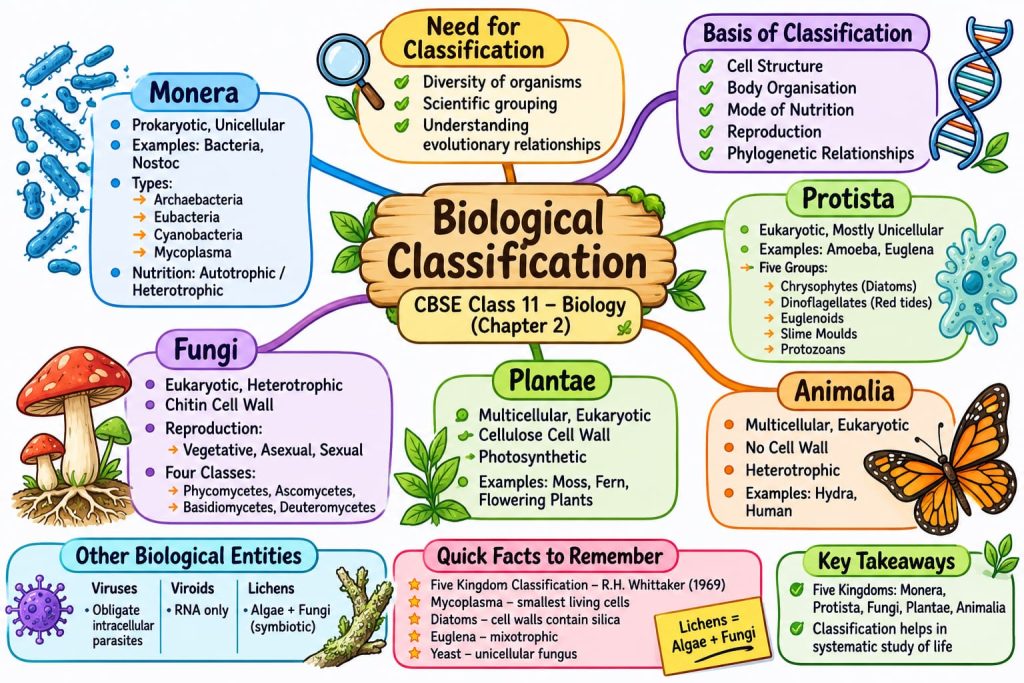
9. Comparison of the Five Kingdoms
| Characteristics | Monera | Protista | Fungi | Plantae | Animalia |
|---|---|---|---|---|---|
| Cell type | Prokaryotic | Eukaryotic | Eukaryotic | Eukaryotic | Eukaryotic |
| Organisation | Unicellular | Mostly unicellular | Mostly multicellular | Multicellular | Multicellular |
| Cell wall | Usually present | Variable | Present | Present | Absent |
| Cell wall composition | Usually peptidoglycan in bacteria | Variable | Chitin | Cellulose | Absent |
| Nutrition | Autotrophic / heterotrophic | Autotrophic / heterotrophic | Heterotrophic | Autotrophic | Heterotrophic |
| Nuclear membrane | Absent | Present | Present | Present | Present |
| Examples | Bacteria | Amoeba, Euglena | Mushroom, yeast | Fern, mango | Human, fish |
Note: The table gives general characteristics. There are exceptions within individual kingdoms.
10. Important Differences for Examinations
A. Prokaryotic and Eukaryotic Cells
| Prokaryotic | Eukaryotic |
|---|---|
| True nucleus absent | True nucleus present |
| Nuclear membrane absent | Nuclear membrane present |
| Membrane-bound organelles absent | Membrane-bound organelles present |
| 70S ribosomes | 80S cytoplasmic ribosomes |
| Generally smaller | Generally larger |
| Example: Bacteria | Example: Amoeba, plants, animals |
B. Fungi and Plants
| Fungi | Plants |
|---|---|
| Lack chlorophyll | Usually possess chlorophyll |
| Heterotrophic | Mainly autotrophic |
| Cell wall mainly made of chitin | Cell wall mainly made of cellulose |
| Food is stored mainly as glycogen and oils | Food is generally stored as starch |
| Nutrition by absorption | Nutrition mainly through photosynthesis |
C. Bacteria and Viruses
| Bacteria | Viruses |
|---|---|
| Cellular organisms | Acellular entities |
| Prokaryotic | No cellular organisation |
| Contain DNA and RNA | Genome contains either DNA or RNA |
| Have ribosomes | Lack ribosomes |
| Reproduce independently under suitable conditions | Replicate only inside living host cells |
| Some can be grown on artificial culture media | Require living cells for replication |
11. Important Scientific Terms
| Term | Meaning |
|---|---|
| Prokaryote | Organism lacking a true membrane-bound nucleus |
| Eukaryote | Organism having a true nucleus |
| Autotroph | Organism that prepares its own food |
| Heterotroph | Organism that depends on other organisms for food |
| Saprophyte | Organism obtaining nutrients from dead organic matter |
| Parasite | Organism living on or inside a host and obtaining nutrients from it |
| Hyphae | Thread-like fungal structures |
| Mycelium | Network of fungal hyphae |
| Pellicle | Flexible protein-rich covering of euglenoids |
| Plasmodium | Multinucleate mass of cytoplasm in slime moulds |
| Pseudopodia | Temporary cytoplasmic projections used for movement and feeding |
| Capsid | Protein coat of a virus |
| Capsomere | Structural unit of a viral capsid |
| Phycobiont | Algal or cyanobacterial partner in a lichen |
| Mycobiont | Fungal partner in a lichen |
| Viroid | Infectious agent made of small RNA without a protein coat |
| Conidia | Asexual spores produced externally by fungi |
| Ascospore | Sexual spore produced inside an ascus |
| Basidiospore | Sexual spore produced externally on a basidium |
15. Quick Revision – Must Remember Facts
| Scientist / Concept | Important fact |
|---|---|
| R.H. Whittaker | Five-kingdom classification, 1969 |
| Carolus Linnaeus | Two-kingdom classification |
| Ivanowsky | Filterable infectious agent |
| Beijerinck | Coined contagium vivum fluidum |
| W.M. Stanley | Crystallised TMV |
| Methanogens | Produce methane |
| Halophiles | Live in salty environments |
| Thermoacidophiles | Live in hot and acidic environments |
| Diatoms | Silica cell walls |
| Dinoflagellates | Red tides |
| Euglena | Mixotrophic nutrition |
| Amoeba | Pseudopodia |
| Paramecium | Cilia |
| Slime moulds | Plasmodium |
| Ascomycetes | Ascospores |
| Basidiomycetes | Basidiospores |
| Deuteromycetes | Imperfect fungi |
| Lichens | Alga + fungus |
| Mycorrhiza | Fungus + plant roots |
| Viroids | Naked infectious RNA |
Also Read- The Living World
A Note from the Author: As an educator with a background in Life Sciences and Biotechnology, I aim to simplify complex topics for students and curious minds. However, science is a rapidly evolving field. While I strive for accuracy, please use these resources as a supplement to—not a replacement for—official curriculum textbooks or professional medical consultation.